Friday, January 27, 2012

The best new think tanks in the world

In 2011 list eight (8) think tanks represent developing countries, five (5) think tanks are located in the United States and three (3) in Germany. However, there are no think tanks from Eastern Europe and the former USSR in the list. The majority of think tanks in the list are engaged in tackling global economic challenges.

1. Google Ideas –  US/UK. The feedback tool of Google where users submit and vote on ideas about how to improve the Google site.

2. Institute for New Economic Thinking (INET) – US. The Institute for New Economic Thinking (INET) was established to broaden and accelerate the development of new economic thinking.
3. China Center for International Economic Exchanges (CCIEE) – China. The mission of CCIEE is to promote international economic research and exchanges and to provide consulting services.

4. Dusseldorf Institute for Competition Economics (DICE) – Germany

5. Macdonald-Laurier Institute (MLI) – Canada. The founders of the Institute strive to to make poor quality public policy in Ottawa unacceptable to Canadians and their political and opinion leaders by proposing alternatives through non-partisan and independent research and commentary.

6. Res Publica – United Kingdom. Res Publica is focused on developing practical solutions to enduring socio-economic and cultural problems such as poverty, asset inequality, family and social breakdown, and environmental degradation.

7. Adelphi Berlin – Germany. Adelhi offers solutions and services on global environment and development challenges which contribute to sustaining natural life systems and fostering sustainable enterprises.
 
8. New Economy Network (NEN) – US. The mission of NEN is to support a transition to a new economy where the priority is to sustain people and the planet, social justice and cohesion are prized, and peace, communities, democracy and nature all flourish.

9. Casablanca Institute – Morocco. The objective of the Institute is to make permanent the interfaith dialogue between Christians, Muslims and Jews.

10. African Center for Leadership, Strategy and Development – Nigeria

11. Econwatch Society of Political Analysis – Germany

12. Cambridge Winter Center – United States

13. Institute for Democracy and Economic Affairs – Malaysia

14. Economic Strategies for the 21st Century (e21) – United States

15. Sheikh Saud bin Saqr al Qasimi Foundation for Policy Research – United Arab Emirates

16. Institut des Hautes Etudes sur les National Unies (IHENU) – France

17. Audace Institut Afrique (AIA) – Cote d’Ivoire

18. Amadeus Center – Morocco

19. Grattan Institute – Australia

20. Fundación Centro de Pensamiento Primero – Colombia

Establisher - International Relations Program, University of Pennsylvania

Umberto Eco about European identity

The writer and semiologist advocates a sexual revolution to make us all 'European'

Umberto Eco
‘The Erasmus idea should be compulsory – not just for students, but also for taxi-drivers, plumbers and other workers,’ says Eco.

Photograph: Sarah Lee for the Guardian

Outside Umberto Eco's office window in Milan looms the intimidating mass of Sforzesco castle, a reminder, with its towers and blackbirds, of various continental wars. Here once stood the 14th-century Castrum Portae Jovis – the Porta di Giove fortress – which was destroyed by the short-lived Aurea Republic of 1447. Between these walls, Leonardo Da Vinci and Donato Bramante once laboured; these very buttresses were conquered by Napoleon. And just beyond the moat – an area now invaded by tourists who have come to visit Michelangelo's La Pietà Rondanini – Marshall Radetzky's Austrian troops bombed the rioting city in 1848.

"When it comes to the debt crisis," says Eco, "and I'm speaking as someone who doesn't understand anything about the economy, we must remember that it is culture, not war, that cements our [European] identity. The French, the Italians, the Germans, the Spanish and the English have spent centuries killing each other. Today, we've been at peace for 70 years and no one realises how amazing that is any more. Indeed, the very idea of a war between Spain and France, or Italy and Germany, provokes hilarity. The United States needed a civil war to unite properly. I hope that culture and the [European] market will do the same for us."

Eco sips his coffee, preferring suitably postmodern Nespresso capsules, whereas his German wife, Renate Ramge Eco, defends the traditional Italian coffee pot, the moka. He has just returned to Milan from Paris, where the French president, Nicolas Sarkozy, conferred on him the rank of commander, the third rank of the Legion of Honour.

"Those were the hours of France's battle for the AAA rating, but Sarkozy still didn't want to miss it – great. I must admit it was also a moving experience when I was conferred the Dodecaneso Cross in Greece: they hand them out right inside Patmos cave, where St John wrote the Apocalypse," says the writer, with a laugh.
"One of the advantages of living in Europe is that I get birthday greetings from the German president, Wulff, and the Spanish prime minister, Rajoy, neither of whom I know. After being at each other's throats for years in fratricidal wars, we're now all culturally European."

Asked to describe European identity in 2012, Eco says it is widespread but "shallow". "I am using an English word that is not the same as the Italian word superficiale, but which is somewhere between 'surface' and 'deep'. We must change this, before the crisis strips it [Europe] of everything.

"The university exchange programme Erasmus is barely mentioned in the business sections of newspapers, yet Erasmus has created the first generation of young Europeans. I call it a sexual revolution: a young Catalan man meets a Flemish girl – they fall in love, they get married and they become European, as do their children. The Erasmus idea should be compulsory – not just for students, but also for taxi drivers, plumbers and other workers. By this, I mean they need to spend time in other countries within the European Union; they should integrate."

It's an attractive idea, and yet pride in Europe appears to be giving way to populism and hostility within the union. "That's why I said that our [European] identity is 'shallow'. The founding fathers of Europe – Adenauer, De Gasperi and Monnet – may have travelled less. De Gasperi spoke only German because he was born within the Austro-Hungarian empire and didn't have access to the internet to read the foreign press. Their Europe reacted to war and they shared resources to build peace. Now we must work towards building a more profound identity.

"When I proposed at a meeting of EU mayors the idea of also introducing Erasmus for craftsmen and professionals, a Welsh mayor said: 'My citizens would never accept this!' And when I spoke about this a few days ago on English television, I was slapped down by the anchorman, who was worried about the euro crisis, about a supranational Europe and about the technical governments of Papademos in Greece and Monti in Italy who were not 'elected', and are therefore 'undemocratic'.

"How should I have responded? By saying that ours is a government approved by parliament and proposed by a president elected by parliament? By saying that in all democracies there are unelected institutions, such as the Queen of England, and the American supreme court, but that no one defines them as non-democratic?"

Even before the debt crisis, Europe's weak identity – as diagnosed by Eco – was apparant. "[For instance,] when the constitution was rejected in a referendum. The document had been written by politicians; it was impossible for any educated man to participate in the process and it was never discussed with voters. It was also evident when euro banknotes were designed without the usual faces of important men and women – instead, there were just frigid landscapes, as in a De Chirico landscape. Or does the problem [of European identity] go back to God - the fact that the United States becomes ever more religious as Europe becomes even less religious?

"That's the way it is. Back when Pope Wojtyla was still alive, there was much discussion on whether they should accept the European constitution and the continent's Christian roots. Secular people predominated and they did nothing about it. The church protested. There was however a third way, more difficult, but one that would give us strength today.

And that would have been to speak of the constitution of all our roots – the Greek-Roman, the Judaic and the Christian. In our past, we have both Venus and the crucifix, the Bible and Nordic mythology, which we remember with Christmas trees, or with the many festivals of St Lucy, St Nicolas and Santa Claus. Europe is a continent that was able to fuse many identities, and yet not confuse them.

That is precisely how I see its future. As for religion: be careful. Many people who no longer go to church end up falling prey to supersitition. And many who are non-practising still carry around a little saint card with a picture of Padre Pio in their wallets!"

Father of semiology, scholar of mass culture, author of essays for the elite and global bestsellers – from The Name of the Rose to The Prague Cemetery, Eco has just turned 80. Whenever he gets tired climbing a flight of stairs, he jokes: "Eh, my friend, we're not 70 any more!"

He is no pessimist: "With all of its defects, the global market makes war less likely, even between the USA and China. Europe will never be the United States of Europe, a single country with a common language like the USA – where for a long time English was threatened to be overtaken by German, now overtaken by Spanish.

"We have too many languages and cultures, indeed, the idea of an unique [European] newspaper is for now just a utopia. The web, meanwhile, makes us bump into one another; we may not read Russian but we come across Russian websites and we are made aware of others.

"I still think that there is no longer a disparity between Lisbon and Warsaw, just as there is no disparity between San Francisco and New York. We will remain a federation, but indissoluble."

So whose faces should we print on our banknotes, to remind the world that we are not merely 'shallow' Europeans, but profound? "Perhaps not politicians or the leaders who have divided us – not Cavour or Radetzky, but men of culture who have united us, from Dante to Shakespeare, from Balzac to Rossellini.
"And since Pierre Bayard is right, we know there are books we have yet to read that will help us reflect on cultures different from our own. Little by little: that is how our European identity will become more profound."

Guardian

Saturday, January 21, 2012

Panama's economic success

In 2011 Panama became a net exporter of remittances. It reported outward remittances of just over $1bn in 2011. This was money sent by foreigners who live and work in Panama to their home countries, mainly the United States and Colombia.

What is driving the phenomenon is the $15bn in public works projects that has been pledged by the president of Panama, Ricardo Martinelli. The projects include huge hospital complexes, a Metro system for the capital, a massive conference centre and, of course, the $5.2bn expansion of the Panama Canal, the biggest infrastructure project in Latin America.

Financial Times

Mexico's 2012 upcoming presidential elections


For many Mexicans, the transition to democracy since 2000 has become a synonym for political paralysis. The actors lack incentives beyond those that drive their own short-term interests. Faced with a growing disenchantment with the results of this imperfect democracy, nostalgia for the past has taken on a romantic appearance. “They may have been corrupt, but they knew how to govern” is a phrase that you now often hear over dinner table in homes throughout Mexico.

That nostalgia for the past has positioned the PRI as the favourite for the elections without its so much as having to wash its face.

However, 12 years of alternating power has forever changed citizens’ attitudes, strengthened some institutions and shaken up the de facto powers – all sufficiently to make it difficult to return to an authoritarian regime.

The result of the 2012 elections will push one way or the other. If the PRI wins with such a big margin that it ends up controlling Congress, the temptation for Peña Nieto to become a Mexican Putin will be immense. The public’s yearning for a crack-down on organised crime will only encourage him further. The deterioration of the security situation in Mexico is a tailor-made alibi for an authoritarian government and a big win would look like a blank cheque sent directly from the people.

But a narrow victory would leave Congress divided and would force the new administration to negotiate its agenda with the opposition. That would make the emergence of an all-powerful government much more difficult.

Financial Times

Friday, January 20, 2012

Le génocide arménien : le négationnisme d'Etat turc


Manifestation à Paris d'opposants au texte de loi pénalisant la négation des génocides. AFP/MARTIN BUREAU


Comment la recherche sur le génocide arménien avance-t-elle, malgré tout, en Turquie ?
Il y a une élite intellectuelle de très grande qualité, qui a compris qu'il y avait un devoir à la fois scientifique et civique de se saisir du refoulé, d'envisager les questions interdites : le génocide arménien, la nature de l'Etat kémaliste, présenté en Turquie comme le modèle indépassable alors qu'il s'apparente aussi à des formes de dictature, la guerre contre les Kurdes, la situation de l'"Etat profond", le pouvoir militaire, les réseaux religieux…

Ils veulent ouvrir ces dossiers, et sont prêts à prendre des risques considérables : Taner Akçam a été emprisonné, avant de devoir s'exiler ; Hrant Dink, qui lui aussi a mené un travail très important avec sa revue bilingue arméno-turque, a été assassiné en 2007 dans un contexte de chasse à l'homme. Hrant Dink a été visé parce que ses travaux tendaient à rappeler combien la société turque est en réalité mélangée, complexe, et que c'est la prise en compte de ce tissage – souvent tragique – qui permettrait de faire la paix avec le passé et de préparer l'avenir. Et puis il n'y a pas que les problèmes ethniques et religieux, il y a la place du genre, des femmes, des homosexuels…
Pour le gouvernement turc, le fait que des universitaires se décident à étudier ces pans du passé constitue une menace pour l'intégrité de la nation, pour la mémoire de Mustafa Kemal. Ils ne peuvent plus incriminer un complot de l'étranger, même s'ils essaient par tous les moyens de discréditer ces recherches et d'imposer le silence aux chercheurs, y compris en recourant à l'emprisonnement et aux procès arbitraires. Il est certain que le vote de la loi va rendre encore plus difficile leur travail en les faisant passer, encore davantage, pour des ennemis intérieurs.

Comment les intellectuels turcs peuvent-ils se tirer du piège dans lequel la loi votée par l'Assemblée française le 22 décembre les place : soutenir la loi, au risque de passer pour ennemis de la nation, ou la rejeter, au risque de devoir s'allier à ceux qui nient le génocide ?
Lorsqu'il y avait eu la première tentative française de pénalisation de la négation du génocide, en 2006, Hrant Dink et d'autres intellectuels démocrates avaient protesté contre une loi qui menacerait leurs recherches. En 2011, certains, notamment les membres de l'association des droits de l'homme turque, ont souligné que le plus important est de combattre le négationnisme.
Ils soulignent la vacuité des arguments officiels, notamment lorsque le pouvoir affirme que cette loi française est contraire à la liberté d'expression : en Turquie, la liberté d'expression sur ces sujets-là n'existe pas.

Tout de même, il est possible aujourd'hui, en Turquie, d'affirmer qu'il y a eu un génocide…
Le nouveau pouvoir dit "islamiste modéré" a créé l'illusion, à partir de 2002, qu'il était porteur d'une vraie démocratisation. Il y a eu des évolutions, indéniables, sur le plan de la liberté d'expression, surtout sur les sujets mettant en cause le régime kémaliste. Mais lorsqu'ils s'intéressent aux liens entre le gouvernement et les religieux, les journalistes sont aussitôt emprisonnés.

Cette relative démocratisation a permis des avancées comme l'édition et la traduction d'ouvrages, ou l'organisation de colloques sur les événements génocidaires de la Première Guerre mondiale, ou sur les massacres d'Adana de 1909. Mais depuis la fin 2009, il y a eu un raidissement considérable. Les intellectuels et historiens qui travaillent sur le passé vivent sous la menace permanente d'arrestations et de procès. C'est dans ce contexte, et pour soutenir ces chercheurs, que nous avons créé, à Paris, un groupe international de travail (GIT) "Liberté de recherche et d'enseignement en Turquie". Plusieurs branches sont déjà créées ou en cours de fondation, en France, aux Etats-Unis, en Grande-Bretagne, et en Turquie même, bien sûr. Il s'agit de déployer la recherche sur la recherche, et de mettre sous surveillance les pouvoirs qui terrorisent les chercheurs.

Comment les intellectuels turcs ressentent-ils que ce soit la France qui se penche, par la loi, sur leur passé ?
La vérité historique ne nécessite pas une loi pour se fonder. C'est même un risque d'affaiblissement. Mais il faut considérer l'importance de l'offensive négationniste. Ce que veulent les autorités turques, ce sont des commissions constituées uniquement d'historiens turs et arméniens. Or l'Arménie a tant besoin de la Turquie que cela ne peut être qu'un marché de dupes. Il faudrait des commissions plus larges : cette question dépasse du reste le cadre historiographique des deux pays.

Reste que même une loi pleine de bons sentiments amène un encadrement de la recherche, donc son affaiblissement, alors même que les travaux sur le génocide arménien demeurent insuffisants. La demande légitime des Arméniens de lire et de retrouver leur histoire est paradoxalement menacée. L'histoire du génocide arménien reste sous-dimensionnée. Il n'y a pas de chaire sur ces questions, d'étude d'histoire comparée sur les génocides, les publications sont peu nombreuses, les maisons d'édition fragiles. Des ouvrages majeurs sur les génocides – incluant le premier des génocides comme A Problem from Hell. America and the Age of Genocide de la politiste d'Harvard Samantha Power (2002) – ne sont toujours pas accessibles en langue française…

Même si cette loi peut se comprendre, elle aura des effets dangereux sur la recherche en Turquie et en France. D'autant que le jusqu'au-boutisme des associations, déjà puissant à l'époque des affaires Bernard Lewis et Gilles Veinstein, risque d'amener les chercheurs à se désengager de ce terrain. Il y a un vrai risque pour la recherche indépendante. La loi vise à défendre la vérité historique, mais elle en sape les bases théoriques et morales.

Mais si on ne peut pas faire de lois, comment lutter contre le négationnisme ?
La vraie solution, c'est de développer la recherche. Si un pouvoir politique veut lutter contre le négationnisme, il peut créer des chaires, ouvrir des laboratoires, soutenir des publications… Il peut aussi défendre le travail des chercheurs sur le terrain. Il est ainsi regrettable que la France n'ait pas voulu soulever la question des intellectuels persécutés en Turquie. Quand le ministre des affaires étrangères, Alain Juppé, est allé à Ankara, en novembre dernier, il ne s'est pas inquiété du sort des chercheurs emprisonnés… La mise au clair du passé, en Turquie, ne se fera que par l'évolution de la société. Cette évolution est en cours mais elle risque d'être bloquée par cette loi. Et les historiens indépendants en payeront à nouveau le prix fort.

Le Monde

Monday, August 22, 2011

Le Canada bien décidé à ne pas perdre son Grand Nord


Crédits photo:Patrick Kelley.

INFOGRAPHIE - Ottawa a engagé une vaste opération militaire en Arctique, nouvelle terre promise. 

Alors que le réchauffement climatique rend les richesses du Grand Nord de plus en plus accessibles, le Canada se prépare à des conflits. Pour mieux y faire face, il vient de lancer la plus vaste mission militaire qu'il a menée jusqu'ici, dans l'Arctique, avec ses homologues américains et danois. Nom de code «Nanook 11».

Les exercices pour défendre la souveraineté d'Ottawa dans le Grand Nord se dérouleront jusqu'à la fin août dans les détroits de Lancaster et de Davis, dans la baie de Baffin et sur l'île de Cornwallis. Si les effectifs déployés par le ministère de la Défense, 1100 hommes des trois armes, demeurent modestes, à l'échelle des moyens du Canada, le pays se prépare activement à des interventions dans le Nord. Ottawa a récemment augmenté les effectifs de ses rangers inuits chargés de défendre la région arctique et modernisé leurs équipements.

Le déploiement de troupes dans l'Arctique, avec la participation de forces alliées, est un message à destination de la Russie, le principal concurrent du Canada dans la région. «Le Nord, c'est à nous. On veut démontrer à nos partenaires internationaux (…) que nous sommes présents. C'est notre but», a confié le capitaine de corvette Luc Tremblay, à Radio-Canada.

Permis d'exploration pétrolière 

La Russie a annoncé vouloir élargir ses frontières arctiques en déposant à l'ONU en 2012 une demande d'extension de son plateau continental. Au début de son premier mandat, en 2006, le premier ministre conservateur, Stephen Harper, ne jurait que par le développement de la composante militaire dans le Grand Nord. Désormais, Ottawa cherche des alliés et multiplie les missions scientifiques et de relations publiques pour montrer au monde que l'Arctique est canadien.

Avec le titre d'ambassadeur de France chargé des négociations internationales relatives aux pôles Arctique et Antarctique, Michel Rocard, a ainsi participé la semaine dernière à un voyage sur le brise-glace québécois Admundsen. Le réchauffement climatique favorise les déplacements des navires dans l'Arctique. En juillet, la banquise a atteint, selon le US National Snow and Ice Data Center, un seuil minimum record pour un mois de juillet, à tout le moins depuis l'existence des premières mesures satellites sur le sujet en 1979. Dès lors, la guerre est déclarée pour le contrôle du pétrole, du gaz naturel et des immenses ressources halieutiques dans l'Arctique.


Le crabe des neiges pourrait bientôt avoir goût de pétrole. Le ministère des Affaires autochtones et du Nord a accordé des licences d'exploration aux compagnies pétrolières Husky Energy, ConocoPhilips, Imperial Oil, MGM Energy et Shell en mer de Beaufort et dans le Grand Nord canadien. L'Arctique est la nouvelle terre promise des compagnies pétrolières.

«Ces territoires représentent un intérêt stratégique pour nous», a confirmé récemment la porte-parole de Husky Energy, Colleen McConnell. Les ressources de pétrole et de gaz de l'Arctique représenteraient environ un cinquième des réserves d'hydrocarbures non découvertes de la planète. Le gouvernement conservateur a écarté tout moratoire d'exploration pétrolière dans le Grand Nord.

L'an dernier, peu après la catastrophe écologique de BP, Stephen Harper s'était fait rassurant. «La réglementation est très stricte au Canada», avait certifié le chef du gouvernement. Ce que contestent à peu près tous les groupes écologistes. Dans l'un de ses documents sur l'Arctique, le World Wildlife Fund Canada déplore: «Notre réglementation est trop laxiste… Aucune technique n'a encore été mise au point pour nettoyer le pétrole dans les eaux couvertes de glace.»

Plus difficile que l'Afghanistan 

Un rapport publié début août par l'Office de l'énergie du Canada révèle qu'en cas de catastrophe pétrolière les opérations de nettoyage ne pourraient pas se dérouler un jour sur cinq si une marée noire avait lieu en juillet et quatre jours sur cinq si celle-ci avait lieu en octobre, en raison des conditions climatiques extrêmes. Les militaires canadiens semblent donner raison aux écologistes. Le capitaine Tremblay ne reconnaît-il pas lui-même? «C'est un environnement extrêmement difficile. L'Arctique est parfois plus difficile que l'Afghanistan. Notre plus gros problème est la logistique, mais aussi de savoir combien de temps nous pouvons travailler dans le froid.»

Source - Radio Canada

Friday, August 5, 2011

Canine Caregivers: Dog “Therapists” Trained To Help Elderly, Alzheimer's Patients

A pack of pups is proving to be a big hit in the La Roseliere retirement home in France, where residents just can’t resist the charms of the big silly tail waggers. Other area nursing homes are also starting to experiment with dog therapy.

Golden Retreivers and Black Labs are reputed to be gentle and sociable breeds

Golden Retreivers and Black Labs are reputed to be gentle and sociable breeds

By Martine Laronche
LE MONDE
/Worldcrunch

KUNHEIM -- Tracy, Dakar, Upton and Virgule are dearly loved at the La Roseliere retirement home in Kunheim, in France’s Alsace Region. These four big and energetic dogs come out all paws blazing to fulfill their mission: to provide the facility’s guests a jolt of happiness and comfort. Their sheer presence tends to do the trick.

Still, this is a proper job for which the pups were well trained. Their education lasted two years: first in a foster home, then in a specialized center. The three Labradors and one Golden Retriever are well behaved and know not to jump on patients, and not to bark. But they do wiggle their tails a lot.

Looks brighten up when these canine caregivers enter the Alzheimer patients’ protected area. The pets receive immediate attention as they sniff and greet patients with their noses. The listless and closed faces light up in front of these lively visitors. An old man pets the black lab and says: “Very very nice, Dakar.” Next to him, a woman holds Upton’s leash and whispers: “He is well-behaved.”

La Roseliere’s director, Robert Kohler, first introduced a dog to the people of this retirement home 11 years ago. It wasn’t easy at first. Some staff resisted, but his experiment provided an opportunity to debate and brainstorm about the needs of the patients.

“Welcoming a pet demonstrates the facility’s openness to the social and cultural rights of the eldery,” said the director. “It’s a fragile demographic that deserves much more attention than others, even though the current tendency is to ignore them.”

Dogs don't judge
The staff has since become convinced of the benefits these pets bring to the guests. The facility houses 127 patients, 30 of whom are in special care for Alzheimer’s. Two specialized nurses, Christelle Wolff and Camille Marchall, have been trained to look after the dogs.

“I can see the difference since I’ve been working with them. Guests use them as a reason to strike up a conversation. It helps with bonding,” says Wolff. “Whenever the guests have a bad night or are anxious, we let them spend 45 minutes with a dog. It puts them at peace. I started involving Dakar in bathing time, and a guest who otherwise always wanted out of the water stayed calm thanks to the dog. It was a magical moment.”

According to Kohler, the animals help fill many emotional and social voids within the institution. “They provide non verbal communication, which offers comfort and security,” he says. “Pets provide unconditional love and affection, and they don’t judge.”

The dogs are trained and are always under the careful watch of the medical staff. There are a few basic rules that apply. The animals are not allowed in the kitchen, and they have to stay out of the trash. Also, La Roseliere’s residents must wash their hands after petting the pooches.

Inspired by his own experience with the dogs, Kohler founded a non-profit for visiting dogs called “Quatre Pattes pour un Sourire” (Four Paws for a Smile). The animals are trained and taken to senior residences free of charge. They visit 23 facilities in the region. There others are wait-listed for lack of appropriate staff.
Today, the organization is staging a pet cleaning workshop at La Roseliere. Participants talk about the dogs’ different names, breed and hair color. The conversation is a good memory exercise. One at a time, the dogs climb on to a little table, where residents brush them. “The exercise validates people,” says Valerie Behra, a Four Paws for a Smile staff member. “They give the dogs simple orders to see if they’ll obey. If it doesn’t work, we repeat the command with them so they don’t experience failure.”

Wednesday, March 16, 2011

¿Por qué los japoneses no lloran?

Supervivientes en Kesennuma. | Efe.

Miguel A. Cristóbal Carle | Madrid

Llama la atención. Durante los últimos días hemos sido bombardeados con imágenes de los daños causados por el terremoto (los terremotos) y el posterior tsunami en Japón: edificios, barcos, coches, fuego, inundaciones. Sin embargo no hemos visto llorar, no hemos visto muertos, ni sufrimiento. Pero ¿es que los japoneses no lloran?

Cuentan que el fotógrafo Richard Avedon quiso fotografiar a los Duques de Kent y no conseguía provocar una muestra de tristeza en sus rostros hablando de tragedias humanas pero dicen que si lo consiguió hablando del atropello de un perro camino del hotel donde se realizaron las fotografías. ¿De qué hablamos? ¿Cómo explicamos esto? Hablamos de diferencias culturales.

La cultura de quien mejor se esconde es de uno mismo. Todo lo que nosotros estamos observando en el comportamiento de la población japonesa, de quien mejor se esconde es de ellos mismos. Si preguntamos a un ciudadano japonés por qué no vemos tragedias, muerte y desesperación, como vimos en Haití, en las matanzas de la mafia en México o incluso tras el tsunami en Tailandia, se mostrará asombrado. Para su cultura es lo normal, lo esperable.

Los británicos son conocidos por controlar sus emociones, positivas y negativas, es lo correcto, lo educado, "lo proper". Los japoneses contienen solo sus emociones negativas por una razón: el respeto, no ofender a quienes les rodean. Nuestras emociones, nuestro dolor puede importunar o aumentar el dolor del otro y la cultura japonesa se basa en el respeto al prójimo y en el buen funcionamiento del grupo.

Sufrimiento interior

En la mitología japonesa, todos los comportamientos que resultan en relaciones positivas con los demás son premiados mientras que las acciones individualistas o antisociales son condenadas. Exteriorizar el sufrimiento implica cargar de energía negativa a quienes nos quieren o simplemente nos rodean. Por eso no vemos imágenes de muertos ni de sufrimiento. Por eso, desde nuestra cultura latina observamos asombrados lo que no entendemos, la contención a la hora de expresar sentimientos negativos como la tristeza y el dolor.

Pero el sufrimiento se lleva por dentro y mora dentro de cada japonés igual que moraría en cualquiera de nosotros. Prueba de ese sufrimiento son las únicas imágenes de dolor que hemos visto, las de niños, incluyendo una niña que sí que lloraba cuando observaba desde un puente como una inmensa ola arrasaba su pueblo. Hablando con un amigo japonés me comentaba que las nuevas generaciones si que están aprendiendo a llorar también por fuera. ¿Fruto de la globalización?

Miguel A. Cristóbal Carle es psicólogo y experto en formación cross-cultural con más de 20 años de experiencia. Es también socio fundador de Healthy Work

El Mundo

Canadian-Ukrainian invests in the Carpathians

VOROHTA, Ukraine – A decade ago, Canadian Ruslana Wrzesnewskyj opened a wooden Alpine-style resort. It wasn’t easy. It took countless trips between her home in Toronto and this remote Carpathian village, seemingly endless talks with local officials and builders and a two-year stint in a culinary school to reach this point.

“It was sheer stubbornness and drive,” she said of her journey in building a small log-cabin resort in Vorohta. With a background in real estate, “I had a plan that I’d like to create an economy in the mountains,” said Wrzesnewskyj, who is the lone foreign investor in Vorohta.

At 58, the Canadian of Ukrainian descent not only runs two businesses on separate continents, she has also been lauded for her humanitarian work with Ukrainian orphans through the Help Us Help the Children foundation. Yet in this tranquil mountainous region, which Ukrainian skiers invade in winter, running a company is far from smooth.

Wrzesnewskyi began to think about opening something of her own after a trip to the Carpathian Mountains where her family comes from in 1993. Back then, she and her husband also committed to adopting a daughter from Ukraine. Opening a business in the Ukrainian mountains seemed like a perfect excuse to keep the family ties alive.

Today, the resort, appropriately named “Khatky Ruslany,” or Ruslana’s cottages, consists of seven cottages and a restaurant, which opened two years ago. Each house is decorated in a different motif including Hutsul, African and Turkish.

It all began on New Year’s Eve 2002 after Wrzesnewskyj secured a plot of land and opened her first two cabins next to former Soviet ski training grounds. Because land ownership by foreigners is troublesome, that asset belongs to a Ukrainian entity, although Wrzesnewskyj is its president. She said when business documents were being prepared she would get annoyed with the employee charged with the paperwork.

“He was obsessive compulsive” to ensure everything was done by the letter of Ukrainian law, Wrzesnewskyj said. Now she is grateful to him because there are no problems with the documentation.

Still, the venture “isn’t profit making” and her Canadian real estate business helps support it, Wrzesnewskyj said. She has invested some $1 million into the resort so far.

Before opening the restaurant, Wrzesnewskyj spent two years in chef school in Canada to get to know that end of the resort business. Part of her graduation exam was to design a restaurant and come up with a menu. Wrzesnewskyj said she wasn’t interested in serving dishes that were widely available in the Carpathians. Instead, she created what she calls “Ukrainian fusion,” a merging of local foods and those Western European palates are more accustomed to.

One dish that has become a hit is a mushroom and pasta affair, which was conceived after Italian tourists brought Wrzesnewskyj wild mushrooms and asked her to do something with them.

Wrzesnewskyj used to visit Kyiv frequently, but now spends most of her time in Vorohta when she is in Ukraine. She spends six to seven months out of the year in the country.  

Every time when I come back to Canada, I think, ‘What the hell am I doing in Ukraine?’” 
- Ruslana Wrzesnewskyj.
This winter, Wrzesnewskyj has been working in the kitchen with staff and transferring culinary knowledge obtained in Canada. “We’ve learned how to work with spices,” cook Mariya Dzemiuk said. “It’s been a real education.”

The resort has proven popular with Ukrainian and foreign tourists. “It is attention to detail…you don’t find anywhere else. It’s a gem in the region,” said Alexa Chopivsky, a Kyiv-based journalist who with a German colleague was visiting on a recent weekend.

The resort has synergized with Wrzesnewskyj’s other passion, her work with Ukrainian orphans.

In 1994, Wrzesnewskyj launched Help Us Help the Children, an organization that since its founding has supported over 200 Ukrainian orphanages and helped some 45,000 children with supplies of medication, food and clothing. The organization also has a scholarship program and a prosthetics program for children with physical disabilities.

The program was started after Wrzesnewskyj and her husband adopted a daughter.

Wrzesnewskyj has annually brought orphans to the Carpathians and enlisted volunteers from Canada and other countries to work as counselors. She said fundraising has become more difficult in the year since President Viktor Yanukovych took office as donors have become uncertain about Ukraine’s future. Still, she has received significant support from local businesses, particularly from the nearby Bukovel ski area, she said.

Wrzesnewskyj’s humanitarian efforts have not gone unnoticed in Canada. She was recently a finalist for the “25 Transformational Canadians” award sponsored by Canada’s national newspaper, The Globe and Mail, and Cisco Canada. The award highlights the work of Canadians who through their vision, leadership and actions have “immeasurably improved the lives of others.”

A friend of former President Viktor Yushchenko, Wrzesnewskyj admitted disappointment in the last five years, saying more should have been done to move the country forward. She noted, however, it has been more difficult to do business under Yanukovych as there has been an uptick in visits from tax inspectors and other government agencies. Those visits take their toll.

“Every time when I come back to Canada, I think, ‘What the hell am I doing in Ukraine?’” Wrzesnewskyj said.

She said she is considering shutting her restaurant this spring for a short period to study a host of new government regulations which affect the resort.

“I need to find out what these draconian laws are all about,” she said.

Natalia A. Feduschak 
Source - Kyiv Post

Monday, March 14, 2011

The hesitant saviour: how Germany bestrides Europe once again


Germany was an empire, a mishmash, a dictatorship, then a shipwreck. For the two decades since reunification, it has at last been a normal country. But it is no sooner normal than it is thrust back on parade. The German chancellor, Angela Merkel, has emerged from the financial crash of 2008 the unchallenged impresario of the eurozone.

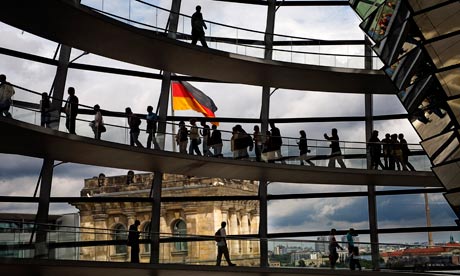
The Reichstag building

The Reichstag building in Berlin: Angela Merkel has emerged from the financial crash of 2008 the unchallenged impresario of the eurozone. 
Photograph: Murdo Macleod for the Guardian
She rescued the currency from disaster last year and salvaged the Greek economy from bankruptcy. She may yet have to do the same for other members of the club. Her country bestrides Europe as it has not done, dare we say it, since the 1940s. This time it does so with a more hesitant leadership and with generosity.

To visit the restored capital of Berlin for the first time in a decade is to see a place transformed. The scars of division have been removed. The wall has gone, as have most traces of the Third Reich. The two greatest traumas of Germany's past have been quietly erased from the Berlin map.

In their place the classical monuments of the Prussian ascendancy are reinstated along the banks of the Spree, like grand old soldiers comforting themselves with their memories.

Beyond is a strange, still bruised city, beset by banal postwar architecture.

Berlin suffers from large building fatigue and cobble-stone starvation. It lacks the boisterous warmth of Munich, the sleek plutocracy of Frankfurt and the bustling commerce of the Rhine. Berliners hate being told how inexpensive their city seems, let alone how empty. It is both.

The Germans I met on this visit were less sensitive and more confident than before, but the introspection remains.

A politician resents tenacious civil servants clinging to their Bonn offices, and bankers clinging to their Frankfurt ones. A publisher is proud that imprints are starting to relocate to Berlin, while an academic complains that Berlin still has newspapers for east and west. A group of journalists argues over whether the city is on the up, or is still down, whether it is lost between east and west, or poised to become capital of a united Europe. Everyone wants to know what outsiders think: witness the appetite for English books on Germany, such as Simon Winder's Germania, Peter Watson's The German Genius, and How to be a Kraut by Roger Boyes.

Most Britons still see Germany as a nation where every move is conditioned by history, and a history assumed to be of relentless megalomania.

I have always seen Germany as the opposite, as an advertisement for the cultural and economic virtues of smallness and locality. Apart from the belligerent century from Bismarck to Hitler, Simon Winder's delightful country of trolls and Rhine maidens, forests and beer, efficient factories and clean hotels, fostered the Reformation, the northern Renaissance and the industrial revolution with none of the trappings of super-statehood.

When in 1945 the allies methodically settled down to create a constitution to "keep Germany down", they opted for the historicism of pre-Bismarckian principalities and "free cities".

The economic miracle was rooted not just in the German work ethic, but in decentralisation, civic competition and enterprise.

I used to think Germany was like Britain without London and the south-east. Everyone was a provincial, and the better for it. The revival of Berlin has not ended that. Germans call themselves Bavarians or Saxons or Berliners.

Germany remains an essentially dispersed country. Its rulers and much of its cultural life may have returned to the new capital, but its finances are in Frankfurt, its industry in the Ruhr and its newspapers in Munich and Frankfurt.

The constitution bequeathed Germany a deliberate weakness, a surfeit of coalitions, lander autonomy and constant elections. But a democracy of which Germans had almost no experience proved vigorous. The ease with which West Germans absorbed their eastern neighbours after 1989, at a cost of over €1 trillion, was astonishing. Germany has none of Britain's dysfunctional contempt for "out of London".

This fusion of democracy and industrial strength remains Germany's central asset. It is maddening for Anglo-American "liberals" to find German social corporatism still performing well, with its cartelised finance and its management-union committees.

The result was that, from 2000 until the crash, German labour costs were persistently falling, while British and French costs were rising.

During the recession German employers did not lay off staff as demand plummeted, but workers accepted wage cuts and banks helped firms over the trough. The result was they emerged from the recession with workforces intact and ready to expand. But as visitors marvel at last year's 3.7% growth rate, Germans see risks on all sides.

The country is not replacing its population and is ageing and retiring. The injection of 4.3 million East Germans is now at an end.

The country has a dwindling labour pool and a population sustained only by immigration. Berlin's council for integration and migration predicts that by 2050 half of all Germans will be of non-German origin.

Many of these will be Turks, whose lack of work ethic and inability to benefit from Germany's archaic school system, while living off welfare, is a constant political theme.

Over the past 10 years the percentage of Germans who feel society is "unfair" rose from a half to three-quarters.

While this might be considered a German matter, a German matter belongs to Europe if Germany turns in on itself.

The crucial relationship now is with France, a nation that defeated Germany once in the past two centuries and was defeated by Germany three times.

It is no longer bonded by the old joke of Germany covering for French weakness and France covering for German strength.

The French president, Nicolas Sarkozy, badly needs German fiscal and budgetary discipline within the euro, to curb his unions and his voracious public sector. He has virtually invited Bismarck to the gates of Paris.

The euro was accepted reluctantly by the Germans in place of the deutschmark, as a talisman of European union and a way of protecting Germany's export markets across Europe.

By last year, popular opinion would have happily reverted to the old currency. In Greece at the time I noticed the virulent anti-German sentiment that precisely mirrored the anti-Greek sentiment of the Germans. The German tabloid Bild sent reporters to hand out bundles of old drachmas to passers-by in Athens, a gesture of either satire or contempt.

In 1989, in a total misreading of modern Europe, Margaret Thatcher fiercely opposed German reunification. "We've beaten the Germans twice and now they're back," she said. But she was right about their being back.

The idea of any nation "leading" a federation as diverse and financially corrupt as the European Union is full of instability. There may be no way Germany will allow the euro to fail. It would risk mini-Weimar republics all round its borders.

But much will depend on it being led by politicians with the comparative sensitivity of Merkel and her predecessor, Gerhard Schröder. It will depend on German "leadership-lite".

This month's negotiations on a "pact for the euro", from which Britain stands aloof, proposes new economic discipline on the euro nations, regulating their budgets, their debts and their taxation policy. It envisages one large macro-economy, with Germany in the vanguard.

This is the price German voters demand for continued resource transfers to weaker states. It is the "ever-closer union" that sceptics claim will yield a brittle political economy, Germanic and dirigiste at the centre, Latin and rebellious at the fringe.

This is the Europe the new Germany is now cast to lead. It has been given precious little time to mature into its new hegemony, but neither it nor Europe has any option.

Source - Guardian