Saturday, September 4, 2010

Top 20 companies: Climate change leaders show the way

СlimateChangeCorp.com picks its favourite firms set to inspire others to follow their environmental lead
By Mike Scott

Climate change has gone from being a marginal issue to being at the forefront of business leaders’ minds. The scientific evidence has been growing for years and this year’s IPCC reports appear to have settled the debate about whether man-made climate change is happening.

However, the issue’s move to the centre stage has come about thanks to a range of disparate events, including Hurricanes Rita and Katrina, which devastated the Gulf of Mexico coastline of the US in 2005 and were attributed, wrongly or rightly, to climate change.

Al Gore’s Oscar-winning film An Inconvenient Truth brought the subject to a mass audience, while The Economics of Climate Change by Sir Nicholas Stern, helped explain why action now was vital, rather than leaving future generations to deal with the problem.

The establishment of the European Union’s Emissions Trading Scheme, also in 2005, is starting to focus minds on the cost of carbon, but there is a case for saying that it was another event in the same year that really focused the minds of the business community – the launch of GE’s ecomagination initiative.

When a company as focused as GE announces that there is money to be made in providing environmental solutions, other companies sit up and take notice.

The companies highlighted in the following pages cover a range of economic sectors, illustrating that the climate change challenge is one that affects every section of the business community.

They are by no means the only companies in those sectors that are taking action, but they have all taken a lead on the basis that early action is not only vital for society as a whole but for the future performance of their business.

The opportunity picks show that it is not just the big beasts that are taking action – many of the most interesting and innovative technologies are emerging from smaller companies and some of the biggest growth stories will come from there, too.

The list also demonstrates that climate change benefits do not just come from the obvious areas such as wind turbines. Demand for products as diverse as high efficiency ball-bearings, ‘smart meters’, low energy computer monitors, financial services and household goods is driven by climate change.

ClimateChangeCorp.com’s top twenty climate friendly companies, large and small:

1) Oil and gas

Leader: Statoil

Ranked the top oil and gas company in the Dow-Jones Sustainability Index, the Norwegian oil and gas company has been storing CO2 from its Sleipner West field in a saline aquifer under the North Sea since 1996, in response to Norway’s introduction of a CO2 tax.

The Norwegian government’s 70% stake and policy that the country should be carbon neutral by 2050 are significant drivers in Statoil’s environmental efforts. The company aims to cut its CO2 emissions by 1.5bn tonnes a year by 2010.

It has invested $12.5m in the World Bank’s Community Development Carbon Fund, which provides finance to projects in the poorer areas of the developing world. In Sweden and Norway, it sells biofuel blends at its petrol stations.

Opportunity Pick: Cosan

Brazil’s largest sugar and ethanol producer is set to raise up to $2bn on the New York Stock Exchange and is expected to scale up production and accelerate acquisition activity in Brazil and Central America, leaving it well-placed to profit from explosion in demand for biofuels.

Sugarcane is a far more effective feedstock for ethanol than the corn that is used in the US and tariffs on Brazilian biofuels in Europe and the US are likely to come down over the long term.

Brazil has by far the most developed biofuels market in the world and the land to expand production to meet demand. The company says that cellulosic ethanol technologies will be more effective for sugarcane bagasse (the waste product from producing sugar) than for corn, further boosting the economics of its product.

2) Power generation

Leader: Iberdrola

The Spanish utility is the world’s largest provider of renewable energy, and has grown rapidly in recent years through acquisition, most recently buying Scottish Power earlier this year.

It has more than 44GW of renewable assets at different stages of development, 95% of it wind power. Most of its current capacity is in Spain, but its pipeline is strongest in the UK, the rest of Europe and, principally, the US. It also has biomass, solar and mini-hydro capacity.

Opportunity Pick: Ocean Power Delivery

A Scottish wave power company, OPD has leapt ahead of its rivals in attempts to bring its devices to market. Three of its Pelamis devices, which use the motion of the waves to drive hydraulic rams and produce energy, are being deployed in the world’s first commercial marine energy project in Portugal, and four machines are set to be installed in Orkney in a Scottish Power-funded project that will be the world’s biggest commercial wave project.

There are also plans for seven Pelamis machines Wave Hub, off the coast of Cornwall, which should be up and running by next year.

3) Retail

Leader: Whole Foods Markets

Despite the controversy over co-founder John Mackey’s e-mail comments about the company’s closest rival, which it wanted to buy, Whole Foods is going from strength to strength.

The company is surfing the wave of ethical consumerism both in the US and, with the opening of a flagship food hall in London, spreading into the UK, whose organic market is predicted to be worth £2.4bn by 2011.

It is committed to buying as much locally-grown seasonal food as it can, to reduce food miles and encourages reduced packaging and energy conservation. It also composts its food waste, cutting the amount it sends to landfill, its new stores are built with green building techniques and its fleet is being converted to biodiesel.

Opportunity Pick: Waitrose

The employee-owned UK supermarket chain focuses on locally-sourced produce, selling more than 1,200 products from within a 30-mile radius of its stores.

The company grows produce on its own farm in Hampshire, which is partly powered by wind and solar power and certified to LEAF (Linking Environment and Farming) standards and grows its own feedstock for biofuels.

It has initiatives to reduce the number of miles driven per £million sales and supports research into community renewables initiatives. It has committed to cutting its CO2 emissions by 10% by 2010, from 2001 levels through a carbon management programme.

4) Transportation

Leader: MTR Corp

MTR operates Hong Kong’s mass transit railway system. It is set to merge Kowloon-Canton Railway Corp and has won a profile-lifting seven-year deal to help operate a new London rail service that will be a vital link for the 2012 Olympics.

In Hong Kong, an eight-year, HK$2bn platform screen doors (PSD) retrofit programme in all its 30 underground stations contributed to a 15% cut in energy use from 2002-2005. The installation of regenerative braking systems, an automatic control system that drives trains at optimum energy usage and monitoring of individual carriages to optimise air-conditioning has also cut power use.

Opportunity pick: Johnson Matthey

The company supplied platinum to Sir William Grove, inventor of the fuel cell, in 1839. Since then, it has become the world’s largest supplier of catalysts and components for fuel cells and is one of the companies best-placed to profit from the hydrogen economy when it eventually arrives.

It is also the biggest maker of catalysts to control emissions from vehicles, supplying one third of all catalysts ever made and a leader in catalysts that reduce volatile organic compound emissions from industrial processes.

Its CRT system can be retrofitted to diesel engines in buses, trucks, trains and stationary applications.

5) Engineering

Leader: SKF

The Swedish company is the world’s largest rolling bearing manufacturer. Its bearings reduce the friction involved with rotation and movement and therefore reduce energy consumption.

As industry strives to reduce energy consumption SKF is likely to see increased demand for its products, which are found in everything from oil refineries to in-line skates to the A-380, the world’s largest airline.

Its bearings can also be found in solar panels and wind turbines and its drive-by-wire products cut energy use and pollution by replacing hydraulic and mechanical processes. The company has a target of cutting its own emissions by 5% every year.

Opportunity Pick: Westport Innovations

Canadian company Westport Innovations has developed a mechanism for running diesel engines on directly injected natural gas.

The technology offers significant reductions in emissions, nitrogen oxides and particulates, compared to conventional engines. The company believes natural gas vehicles provide the bridge from petroleum to hydrogen.

Hydrogen-enriched Compressed Natural Gas (HCNG) improves combustion and offers a viable path, using readily available commercial vehicles, towards the eventual goal of pure hydrogen fuel, as well as offering immediate and material environmental benefits over even natural gas.

Its products are used in heavy-duty and light trucks, buses and passenger cars.

6) Household Goods

Leader: Unilever

One of the world’s largest household goods and food producers, Unilever has reduced CO2 emissions in its manufacturing operations by more than 30% over the past decade in absolute terms.

In 2006, it sourced 14.8% of its energy from renewable sources, of which 8.2% it generated itself. The company has installed video-conferencing facilities in five regional offices to help reduce business travel.

It has introduced ice-cream cabinets that use hydrocarbon (HC) refrigerants instead of CFC or HCFC gases. HC cabinets use up to 9% less energy than older technologies and HC refrigerant does not increase the concentration of greenhouse gases.

Opportunity pick: Ecover

The Belgian company offers phosphate-free cleaning products based on environmentally-friendly ingredients and produced using low-energy manufacturing processes at its eco-factories – it has just opened its third plant in Boulogne to cope with increased demand.

Because the company’s products use plant and mineral-based ingredients rather than fossil-fuel-based chemicals, their total carbon footprint is much lower than traditional cleaning products and they are biodegradable.

7) Financial Services

Leader: HSBC

The world’s third-biggest bank was the first to announce it would go carbon-neutral. It has introduced a range of energy efficiency measures, buys renewable electricity and offsets the emissions it cannot remove.

The bank has launched a $100m partnership on climate change with The Climate Group, Earthwatch Institute, Smithsonian Tropical Research Institute and WWF and Sir Nicholas Stern, author of the seminal report The Economics of Climate Change, has joined the bank as an adviser on its investments..

It has also introduced a global energy efficiency programme that will enable HSBC offices worldwide to showcase environmental innovation and share best practice.

Opportunity pick: Triodos

Netherlands-based ethical bank Triodos, which also operates in the UK, Spain and Belgium, was one of the first institutions to invest in wind power in the 1980s, after the Chernobyl nuclear disaster, and solar power in the 1990s.

Triodos Climate Clearing House, a clearing house for CO2 emission credits, processed its first transactions in 2001. It has invested in companies involved in wind, recycled heat, small-scale hydro-electric power – one of its most recent investments was in Marine Current Technology, which is working to develop the world’s first commercial tidal power scheme.

Triodos also offers customers the opportunity to invest in renewable energy projects through its Renewables Fund.

8) Construction & buildings

Leader: Lafarge

Cement production is one of the biggest emitters in industry, responsible for 5% of all emissions. Lafarge was one of the leaders in establishing the World Business Council for Sustainable Development’s Cement Sustainability Index.

It has committed to a 20% cut in net emissions per tonne of cement worldwide and a 10% cut in absolute emissions in industrialized countries by 2010, from 1990 levels.

Lafarge has also committed 11% of its R&D budget to carbon capture and storage and employs a range of energy efficiency measures including using materials ranging from rice husks to bone meal to scrap car tyres to heat its kilns.

The company aims to secure 14% of its fuel from alternative fuels by 2010.

Opportunity Pick: Itron

With buildings responsible for 40% of carbon emissions, there is a real focus on the sector’s energy performance. Itron is a ‘smart-metering’ company that allows remote meter reading.

Smart meters not only allow utilities to improve efficiency and improve demand response, they can also help consumers manage their domestic energy consumption more effectively.

The meters are vital in tracking energy distributed by micro-generation and sold back to the grid. With an increasing focus on energy efficiency, energy security and distributed generation, the demand for smart metering is likely to be strong and Itron has 50% of the market.

9) Electronics

Leader: Sharp

The Japanese consumer electronics giant is committed to reducing the environmental impact of all of its products including energy consumption during use. It has a target of 40% of its Japanese sales being from green products by 2010, by which time it also aims to be carbon-neutral.

The company’s Japanese manufacturing plant is one of the most environmentally advanced factories in the world. Its ‘Green Seal’ range of high efficiency products includes its range of LCD televisions, which have received the coveted EU Eco-label.

In addition, it is a world-leading producer of solar cells, which it has been producing for 45 years.

Opportunity Pick: Delta Electronics

Taiwan's Delta Electronics makes power management components for PCs, helping to make PCs more energy-efficient as well as providing low-energy visual display units.

As a supplier to companies including Dell, HP, IBM, Intel, Microsoft, NEC, GE and Sony, it is well-placed to benefit from the increased attention on the electricity use of computers.

Its subsidiary DelSolar makes solar cells and is set to expand production to 100MW per year by the end of 2007. Other energy efficiency or environmental products include electronic ballasts, mercury-free displays, AC motor drives, inverters for renewable energies, and fuel cell components.

10) Vehicles

Leader: Honda

While Toyota’s Prius hybrid has taken most of the plaudits, its Japanese rival, which has its own hybrid range, is rated the greenest vehicle maker overall by the Union of Concerned Scientists in the US.

The company has demonstrated a fully-functional fuel cell vehicle, has a hydrogen production and refuelling station at its Los Angeles research unit and is introducing a clean diesel car to the US in 2009, offering lower emissions of both CO2 and particulates.

The company is working on new technology to produce ethanol from soft biomass, including waste wood and leaves, and has a unit that sells thin-film solar cells.

Opportunity Pick: Tanfield

Tanfield’s subsidiary, Smith Electric Vehicles a former milk float maker, is the world’s largest manufacturer of road-going commercial electric vehicles.

Its zero emission trucks and vans can travel at up to 50mph and have a range of 150 miles, making them ideal for commercial fleets within a closed environment, such as airports or with defined routes, such as supermarket home delivery services.

It has won orders from Marks and Spencer, J. Sainsbury, logistics company TNT and Scottish & Southern Energy.

Sales have doubled every year since 2004. The company is building a plant in the US that can produce 1,000 vehicles a year and expects to open another by 2009 that will lift US capacity to 5,000 vehicles a year.

Найкращі та найгірші практики соціальних медіа

НАЙКРАЩІ ПРАКТИКИ
1. Використання соціяльних медіа як інструмента фандрейзингу:
  • Додайте кнопку або віджет "зробіть внесок" до вашого медіаканалу.
  • Уповноважте людей збирати кошти від вашого імені, наприклад facebook causes
  • З'єднайте людей безпосередньо з бенефеціарами, які потребують їх досвіду та послуг, або сприяння обміну досвідом
2. Побудова навколо спільної справи міцної громади: сфокусуйте ваш сайт на якісь конкретній темі, не розпорошуйте сили, змістіть акценти з простого надсилання месиджу на бесіду та обмін досвідом, використовуйте соціяльний networking для формування поінформованості та підтримки.

3. Використовуйте соціяльні медіа для advocacy
  • Інформуйте людей та впливайте на публічну політику
  • Забезпечуйте прихильників регулярними оновленнями стосовно того, що вони можуть зробити, аби адвокатувати вашу спільну справу
  • Створіть інформаційний центр, де волонтери та прихильники можуть отримати усю інформацію для адвокації. Посильте інтерактивність шляхом додавання функцій "вставити відео", "вставити віджет", "вставити банер" тощо.
4. Моніторте простір соціяльних медіа, вивчайте досвід інших.

НАЙГІРШІ ПРАКТИКИ:
1. Застаріла інформація

2. Інформація, що надається нерегулярно

3. Недостатня контактна інформація

4. Непрофесійний веб-дизайн
  • Недостатня інтерактивність
  • Незручність у користуванні
  • Мало фотографій, відео, деталей подій
5. Логотип і теги не відповідають місії та цілям організації

Перелік критеріїв оцінки соціяльних медіа

1. Перегляди сторінки
2. Кількість унікальних користувачів
3. Члени
4. Пости (ідеї, дискусії/теми)
5. Кількість груп (мережі, форуми)
6. Коментарі
7. Теги
8. Рейтинги
9. Час, проведений на сайті
10. Автори
11. Посилання
12. Завершені профайли
13. З'єднання (між учасниками)
14. Співвідношення: між членом та автором, між постом та коментарем, профайлом та постом
15. Періоди: щодня, щомісяця, щороку
16. Частота (візитів, постів, коментарів)

Brazil's foreign-aid programme

Speak softly and carry a blank cheque
In search of soft power, Brazil is turning itself into one of the world's biggest aid donors. But is it going too far, too fast?

ONE of the most successful post-earthquake initiatives in Haiti is the expansion of Lèt Agogo (Lots of Milk, in Creole), a dairy co-operative, into a project encouraging mothers to take their children to school in exchange for free meals. It is based on Bolsa Família, a Brazilian welfare scheme, and financed with Brazilian government money. In Mali cotton yields are soaring at an experimental farm run by Embrapa, a Brazilian research outfit. Odebrecht, a Brazilian construction firm, is building much of Angola’s water supply and is one of the biggest contractors in Africa.

Without attracting much attention, Brazil is fast becoming one of the world’s biggest providers of help to poor countries. Official figures do not reflect this. The Brazilian Co-operation Agency (ABC), which runs “technical assistance” (advisory and scientific projects), has a budget of just 52m reais ($30m) this year. But studies by Britain’s Overseas Development Institute and Canada’s International Development Research Centre estimate that other Brazilian institutions spend 15 times more than ABC’s budget on their own technical-assistance programmes. The country’s contribution to the United Nations Development Programme (UNDP) is $20m-25m a year, but the true value of the goods and services it provides, thinks the UNDP’s head in Brazil, is $100m. Add the $300m Brazil gives in kind to the World Food Programme; a $350m commitment to Haiti; bits and bobs for Gaza; and the $3.3 billion in commercial loans that Brazilian firms have got in poor countries since 2008 from the state development bank (BNDES, akin to China’s state-backed loans), and the value of all Brazilian development aid broadly defined could reach $4 billion a year (see table). That is less than China, but similar to generous donors such as Sweden and Canada—and, unlike theirs, Brazil’s contributions are soaring. ABC’s spending has trebled since 2008.

This aid effort—though it is not called that by the government—has wide implications. Lavishing assistance on Africa helps Brazil compete with China and India for soft-power influence in the developing world. It also garners support for the country’s lonely quest for a permanent seat on the UN Security Council. Since rising powers like Brazil will one day run the world, argues Samuel Pinheiro Guimarães Neto, the minister for strategic affairs, they can save trouble later by reducing poverty in developing countries now.

Moreover, aid makes commercial sense. For example, Brazil is the world’s most efficient ethanol producer, and wants to create a global market in the green fuel. But it cannot do so if it is the world’s only real provider. Spreading ethanol technology to poor countries creates new suppliers, boosts the chances of a global market and generates business for Brazilian firms.

The effort matters to the world’s aid industry, too—and not only because it helps offset the slowdown in aid from traditional donors. Like China, Brazil does not impose Western-style conditions on recipients. But, on the whole, western donors worry less about Brazilian aid than they do over China’s, which they think fosters corrupt government and bad policy. Brazilian aid is focused more on social programmes and agriculture, whereas Chinese aid finances roads, railways and docks in exchange for access to raw materials (though Brazilian firms are busy snapping up commodities in third-world nations, too).

Marco Farani, the head of ABC, argues there is a specifically Brazilian way of doing aid, based on the social programmes that have accompanied its recent economic success. Brazil has a comparative advantage, he says, in providing HIV/AIDS treatment to the poor and in conditional cash-transfer schemes like Bolsa Família. Its tropical-agriculture research is among the world’s best. But Brazil also still receives aid so, for good or ill, its aid programme is eroding the distinction between donors and recipients, thus undermining the old system of donor-dictated, top-down aid.

And all this has consequences for the West. Some rich-country governments cautiously welcome what Brazilians call “the diplomacy of generosity”, just as they do the soft-power ambitions of which aid is part. After all, if (as seems likely) emerging markets are to become more influential, Brazil—stable, democratic, at peace with its neighbours—looks more attractive and tractable than, say, China or Russia.

But if aid is any guide, a lot will have to change before Brazil occupies the place in the world that its president, Luiz Inácio Lula da Silva, aspires to. Brazil seems almost ambivalent about its aid programme. The country still has large pockets of third-world poverty, and sending money abroad could be controversial. Brazilian law forbids giving public money to other governments, so legal contortions are inevitable. The ABC aid agency is tucked away in the foreign ministry, where its officials are looked down on as “Elizabeth Arden” diplomats (London–New York–Paris), not the “Indiana Jones” adventurers required. At least some aid, for example to Venezuela, seems to have been inspired by Lula’s soft spot for leftist strongmen. And the exponential increase in aid—the value of humanitarian contributions has risen by 20 times in just three years—means that both people and institutions are being overwhelmed. Stories abound of broken promises, incompetence and corruption.

Slowly, though, things are changing. Dilma Rousseff, the presidential candidate from Lula’s party, is thought to be mulling over the idea of a new development agency to raise aid’s profile, if elected. As Mr Farani says, Brazil needs more aid officials, with more operational independence and a greater emphasis on policy aims, not just piecemeal projects. Until it gets those, Brazil’s aid programme is likely to remain a global model in waiting—a symbol, perhaps, of the country as a whole.

Source - Economist

CHINA AND INDIA: Contest of the century

AS CHINA AND INDIA RISE IN TANDEM, THEIR RELATIONSHIP WILL SHAPE WORLD POLITICS. SHAME THEY DO NOT GET ON BETTER
Aug 19th 2010

A HUNDRED years ago it was perhaps already possible to discern the rising powers whose interaction and competition would shape the 20th century. The sun that shone on the British empire had passed midday. Vigorous new forces were flexing their muscles on the global stage, notably America, Japan and Germany. Their emergence brought undreamed-of prosperity; but also carnage on a scale hitherto unimaginable.
Now digest the main historical event of this week: China has officially become the world’s second-biggest economy, overtaking Japan. In the West this has prompted concerns about China overtaking the United States sooner than previously thought. But stand back a little farther, apply a more Asian perspective, and China’s longer-term contest is with that other recovering economic behemoth: India. These two Asian giants, which until 1800 used to make up half the world economy, are not, like Japan and Germany, mere nation states. In terms of size and population, each is a continent—and for all the glittering growth rates, a poor one.

Not destiny, but still pretty important
This is uncharted territory that should be seen in terms of decades, not years. Demography is not destiny. Nor for that matter are long-range economic forecasts from investment banks. Two decades ago Japan was seen as the main rival to America. Countries as huge and complicated as China can underachieve or collapse under their own contradictions. In the short term its other foreign relationships may matter more, even in Asia: there may, for instance, be a greater risk of conflict between rising China and an ageing but still powerful Japan. Western powers still wield considerable influence.

So caveats abound. Yet as the years roll forward, the chances are that it will increasingly come down once again to the two Asian giants facing each other over a disputed border (see article). How China and India manage their own relationship will determine whether similar mistakes to those that scarred the 20th century disfigure this one.

Neither is exactly comfortable in its skin. China’s leaders like to portray Western hype about their country’s rise as a conspiracy—a pretext either to offload expensive global burdens onto the Middle Kingdom or to encircle it. Witness America’s alliances with Japan and South Korea, its legal obligation to help Taiwan defend itself and its burgeoning friendships with China’s rivals, notably India but also now Vietnam.
This paranoia is overdone. Why shouldn’t more be asked from a place that, as well as being the world’s most-populous country, is already its biggest exporter, its biggest car market, its biggest carbon-emitter and its biggest consumer of energy (a rank China itself, typically, contests)? As for changing the balance of power, the People’s Liberation Army’s steady upgrading of its technological capacity, its building of a blue-water navy and its fast-developing skills in outer space and cyberspace do not yet threaten American supremacy, despite alarm expressed this week about the opacity of the PLA’s plans in a Pentagon report. But China’s military advances do unnerve neighbours and regional rivals. Recent weeks have seen China fall out with South Korea (as well as the West) over how to respond to the sinking in March, apparently by a North Korean torpedo, of a South Korean navy ship. And the Beijing regime has been at odds with South-East Asian countries over its greedy claim to almost all of the South China Sea.

India, too, is unnerved. Its humiliation at Chinese hands in a brief war nearly 50 years ago still rankles. A tradition of strategic mistrust of China is deeply ingrained. India sees China as working to undermine it at every level: by pre-empting it in securing supplies of the energy both must import; through manoeuvres to block a permanent seat for India on the United Nations Security Council; and, above all, through friendships with its smaller South Asian neighbours, notably Pakistan. India also notes that China, after decades of setting their border quarrels to one side in the interests of the broader relationship, has in recent years hardened its position on the disputes in Tibet and Kashmir that in 1962 led to war. This unease has pushed India strategically closer to America—most notably in a controversial deal on nuclear co-operation.

Autocrats in Beijing are contemptuous of India for its messy, indecisive democracy. But they must see it as a serious long-term rival—especially if it continues to tilt towards America. As recently as the early 1990s, India was as rich, in terms of national income per head. China then hurtled so far ahead that it seemed India could never catch up. But India’s long-term prospects now look stronger. While China is about to see its working-age population shrink (see article), India is enjoying the sort of bulge in manpower which brought sustained booms elsewhere in Asia. It is no longer inconceivable that its growth could outpace China’s for a considerable time. It has the advantage of democracy—at least as a pressure valve for discontent. And India’s army is, in numbers, second only to China’s and America’s: it has 100,000 soldiers in disputed Arunachal Pradesh (twice as many as America will soon have in Iraq). And because India does not threaten the West, it has powerful friends both on its own merits and as a counterweight to China.

A settlement in time
The prospect of renewed war between India and China is, for now, something that disturbs the sleep only of virulent nationalists in the Chinese press and retired colonels in Indian think-tanks. Optimists prefer to hail the $60 billion in trade the two are expected to do with each other this year (230 times the total in 1990). But the 20th century taught the world that blatantly foreseeable conflicts of interest can become increasingly foreseeable wars with unforeseeably dreadful consequences. Relying on prosperity and more democracy in China to sort things out thus seems unwise. Two things need to be done.
First, the slow progress towards a border settlement needs to resume. The main onus here is on China. It has the territory it really wants and has maintained its claim to Arunachal Pradesh only as a bargaining chip. It has, after all, solved intractable boundary quarrels with Russia, Mongolia, Myanmar and Vietnam. Surely it cannot be so difficult to treat with India?

That points to a second, deeper need, one that it took Europe two world wars to come close to solving: emerging Asia’s lack of serious institutions to bolster such deals. A regional forum run by the Association of South-East Asian Nations is rendered toothless by China’s aversion to multilateral diplomacy. Like any bully, it prefers to pick off its antagonists one by one. It would be better if China and India—and Japan—could start building regional forums to channel their inevitable rivalries into collaboration and healthy competition.

Globally, the rules-based system that the West set up in the second half of the 20th century brought huge benefits to emerging powers. But it reflects an out-of-date world order, not the current global balance, let alone a future one. China and India should be playing a bigger role in shaping the rules that will govern the 21st century. That requires concessions from the West. But it also requires commitment to a rules-based international order from China and India. A serious effort to solve their own disagreements is a good place to start.

Source - Economist

India and China: A Himalayan rivalry

Asia’s two giants are still unsure what to make of each other. But as they grow, they are coming closer—for good and bad
Aug 19th 2010 | Beijing, Delhi and Tawang

MEMORIES of a war between India and China are still vivid in the Tawang valley, a lovely, cloud-blown place high on the south-eastern flank of the Himalayas. They are nurtured first by the Indian army, humiliated in 1962 when the People’s Liberation Army swept into Tawang from next-door Tibet. India now has three army corps—about 100,000 troops—in its far north-eastern state of Arunachal Pradesh, which includes Tawang.

With another corps in reserve, and a few Sukhoi fighter planes deployed last year to neighbouring Assam, they are a meaty border force, unlike their hapless predecessors. In 1962 many Indian troops were sent shivering to the front in light cotton uniforms issued for Punjab’s fiery plains. In a weeklong assault the Chinese seized much of Arunachal, as well as a slab of Kashmir in the western Himalayas, and killed 3,000 Indian officers and men. Outside Tawang’s district headquarters a roadside memorial, built in the local Buddhist style, commemorates these dead. At a famous battle site, below the 14,000-foot pass that leads into Tawang, army convoys go slow, and salute their ghosts.

In wayside villages of solid white houses fluttering with coloured prayer-flags, China’s two-week occupation of Tawang is also remembered. Local peasants, aged 60 and more but with youthful Tibetan features, light-brown and creased by the wind, recall playing Sho (Tibetan Mahjong) with the invaders. Many say they remember them fondly: the Chinese, they note, helped get in the wheat harvest that year. “They were little men, but they were always ready to help. We had no problem with them,” says Mem Nansey, an aged potato farmer. The Chinese withdrew to Tibet, their superiority established but their supply lines overstretched, barely a fortnight after they had come. “We weren’t sorry to see the back of them, either,” says Mr Nansey, concerned, it seems, that no one should doubt his loyalty to Delhi, 1,500km (930 miles) to the west.

His ambivalence is widely shared. China and India, repositories of 40% of the world’s people, are often unsure what to make of each other. Since re-establishing diplomatic ties in 1976, after a post-war pause, they and their relationship have in many ways been transformed. The 1962 war was an act of Chinese aggression most obviously springing from China’s desire for western Aksai Chin, a lofty plain linking Xinjiang to Tibet. But its deeper causes included a famine in China and economic malaise in both countries. China and India are now the world’s fastest-growing big economies, however, and in a year or two, when India overtakes Japan on a purchasing-power-parity basis, they will be the world’s second- and third-biggest. And as they grow, Asia’s giants have come closer.

Their two-way trade is roaring: only $270m in 1990, it is expected to exceed $60 billion this year. They are also tentatively co-operating, for their mutual enrichment, in other ways: for example, by co-ordinating their bids for the African oil supplies that both rely on. Given their contrasting economic strengths—China’s in manufacturing, India’s in services—some see an opportunity for much deeper co-operation. There is even a word for this vision, “Chindia”. On important international issues, notably climate-change policy and world trade, their alignment is already imposing.

Their leaders naturally talk up these pluses: at the summit of the BRICs (Brazil, Russia, India, China) in Brasília in April, for example, and during celebrations in Beijing earlier this year to commemorate the 60th anniversary of India’s recognition of the People’s Republic. “India and China are not in competition,” India’s sage-like prime minister, Manmohan Singh, often says. “There is enough economic space for us both.”
China’s president, Hu Jintao, says the same. And no doubt both want to believe it. The booms in their countries have already moved millions out of poverty, especially in China, which is far ahead on almost every such measure of progress (and also dismissive of the notion that India could ever rival it). A return to confrontation, besides hugely damaging the improved image of both countries, would plainly jeopardise this movement forward. That is why the secular trend in China-India relations is positive.
Yet China and India are in many ways rivals, not Asian brothers, and their relationship is by any standard vexed—as recent quarrelling has made abundantly plain. If you then consider that they are, despite their mutual good wishes, old enemies, bad neighbours and nuclear powers, and have two of the world’s biggest armies—with almost 4m troops between them—this may seem troubling.

Forget Chindia
There are many caveats to the recent improvement in their relationship. As the world’s oil wells run dry, many—including sober analysts in both countries—foresee China-India rivalry redrawn as a cut-throat contest for an increasingly scarce resource. The two oil-gluggers’ recent co-operation on energy was, after all, as unusual as it was tentative. More often, Chinese state-backed energy firms compete with all-comers, for Sudanese oil and Burmese gas, and win.

Rivalry over gas supplies is a bigger concern for Indian policymakers. They fear China would be more able to “capture” gas by building massive pipelines overnight. Water is already an object of contention, given that several of the big rivers of north India, including the Brahmaputra, on which millions depend, rise in Tibet. China recently announced that it is building a dam on the Brahmaputra, which it calls the Yarlung Tsangpo, exacerbating an old Indian fear that the Beijing regime means to divert the river’s waters to Chinese farmers.
As for Chindia, it can seem almost too naive to bother about. Over 70% of India’s exports to China by value are raw materials, chiefly iron ore, bespeaking a colonial-style trade relationship that is hugely favourable to China. A proliferating range of Chinese non-tariff barriers to Indian companies, which India grumbles about, is a small part of this. The fault lies chiefly with India’s uncompetitive manufacturing. It is currently cheaper, an Indian businessman says ruefully, to export plastic granules to China and then import them again in bucket-form, than it is to make buckets in India.

This is a source of tension. India’s great priority is to create millions of jobs for its young, bulging and little-skilled population, which will be possible only if it makes huge strides in manufacturing. Similarly, if China trails India in IT services at present, its recent investments in the industry suggest it does not plan to lag for long.

Yet there is another, more obvious bone of contention, which exacerbates all these others and lies at the root of them: the 4,000km border that runs between the two countries. Nearly half a century after China’s invasion, it remains largely undefined and bitterly contested.

The basic problem is twofold. In the undefined northern part of the frontier India claims an area the size of Switzerland, occupied by China, for its region of Ladakh. In the eastern part, China claims an Indian-occupied area three times bigger, including most of Arunachal. This 890km stretch of frontier was settled in 1914 by the governments of Britain and Tibet, which was then in effect independent, and named the McMahon Line after its creator, Sir Henry McMahon, foreign secretary of British-ruled India. For China—which was afforded mere observer status at the negotiations preceding the agreement—the McMahon Line represents a dire humiliation.

China also particularly resents being deprived of Tawang, which—though south of the McMahon Line—was occupied by Indian troops only in 1951, shortly after China’s new Communist rulers dispatched troops to Tibet. This district of almost 40,000 people, scattered over 2,000 square kilometres of valley and high mountains, was the birthplace in the 17th century of the sixth Dalai Lama (the incumbent incarnation is the 14th). Tawang is a centre of Tibet’s Buddhist culture, with one of the biggest Tibetan monasteries outside Lhasa. Traditionally, its ethnic Monpa inhabitants offered fealty to Tibet’s rulers—which those aged peasants around Tawang also remember. “The Tibetans came for money and did nothing for us,” said Mr Nansey, referring to the fur-cloaked Tibetan officials who until the late 1940s went from village to village extracting a share of the harvest.

Making matters worse, the McMahon Line was drawn with a fat nib, establishing a ten-kilometre margin for error, and it has never been demarcated. With more confusion in the central sector, bordering India’s northern state of Uttarakhand, there are in all a dozen stretches of frontier where neither side knows where even the disputed border should be. In these “pockets”, as they are called, Indian and Chinese border guards circle each other endlessly while littering the Himalayan hillsides—as dogs mark lampposts—to make their presence known. When China-India relations are strained, this gives rise to tit-for-tat and mostly bogus accusations of illegal border incursions—for which each side can offer the other’s empty cigarette and noodle packets as evidence. In official Indian parlance such proof is grimly referred to as “telltale signs”. It is plainly garbage. Yet this is a carefully rehearsed and mutually comprehensible ritual for which both sides deserve credit, of a sort. Despite several threatened dust-ups—including one in 1986 that saw 200,000 Indian troops rushed to northern Tawang district—there has been no confirmed exchange of fire between Indian and Chinese troops since 1967.

Hands extended—and withdrawn
It would be even better if the two countries would actually settle their dispute, and, until recently, that seemed imaginable. The obvious solution, whereby both sides more or less accept the status quo, exchanging just a few bits of turf to save face, was long ago advocated by China, including in the 1980s by the then prime minister, Deng Xiaoping. India’s leaders long considered this politically impossible. But in 2003 a coalition government led by the Hindu-nationalist Bharatiya Janata Party—which in 1998 had cited the Chinese threat to justify its decision to test a nuclear bomb—launched an impressive bid for peace. For the first time India declared itself ready to compromise on territory, and China appeared ready to meet it halfway. Both countries appointed special envoys, who have since met 13 times, to lead the negotiations that followed. This led to an outline deal in 2005, containing the “guiding principles and political parameters” for a final settlement. Those included an agreement that it would involve no exchange of “settled populations”—which implied that China had dropped its historical demand for Tawang.

Left, India, right, China, salute
Yet the hopes this inspired have faded. In ad hoc comments from Chinese diplomats and through its state-controlled media—which often refer to Arunachal as Chinese South Tibet—China appears to have reasserted its demand for most of India’s far north-eastern state. Annoying the Indians further, it started issuing special visas to Indians from Arunachal and Kashmir—after having denied a visa to an Indian official from Arunachal on the basis that he was, in fact, Chinese. It also objected to a $60m loan to India from the Asian Development Bank, on the basis that some of the money was earmarked for irrigation schemes in Arunachal. Its spokesman described a visit to Tawang by Mr Singh, ahead of a general election last year, as “provocative and dangerous”. Chinese analysts warn against understanding from these hints that China has formally revised its position on the border. But that is India’s suspicion. And no one, in either country, is predicting a border settlement soon.

In fact, the relationship has generally soured. Having belatedly woken up to the huge improvements China has made in its border infrastructure, enabling a far swifter mobilisation of Chinese troops there, India announced last year that it would deploy another 60,000 troops to Arunachal. It also began upgrading its airfields in Assam and deploying the Sukhois to them. India’s media meanwhile reported a spate of “incursions” by Chinese troops. China’s state-controlled media was more restrained, with striking exceptions. Last year an editorial in the Global Times, an English-language tabloid in Beijing, warned that “India needs to consider whether or not it can afford the consequences of a potential confrontation with China.” Early this year India’s outgoing national security adviser and special envoy to China, M.K. Narayanan, accused Chinese hackers of attacking his website, as well as those of other Indian government departments.

Recent diplomacy has brought more calm. Officials on both sides were especially pleased by their show of unity at the United Nations climate meeting in Copenhagen last December, where China and India, the world’s biggest and fourth-biggest emitters of carbon gas, faced down American-led demands for them to undertake tougher anti-warming measures. A slight cooling in the America-India relationship, which President George Bush had pushed with gusto, has also helped. So, India hopes, has its appointment of a shrewd Mandarin-speaker, Shivshankar Menon, as its latest national security adviser and special envoy to China. He made his first visit to Beijing in this role last month; a 14th round of border talks is expected. And yet the China-India relationship has been bruised.

Negative views
In China, whose Communist leaders are neither voluble nor particularly focused on India, this bruising is mostly clear from last year’s quarrel itself. The Chinese, many of whom consider India a dirty, third-rate sort of place, were perhaps most obviously to blame for it. This is despite China’s conspicuous recent success in settling its other land disputes, including with Russia and Vietnam—a fact Chinese commentators often cite to indicate Indian intransigence. Chinese public opinion also seems to be turning against India, a country the Chinese have been wont to remark on fondly, if at all, as the birthplace of Buddhism. According to a recent survey of global opinion released by the BBC, the Chinese show a “distinct cooling” towards India, which 47% viewed negatively.

In garrulous, democratic India, the fallout is easier to gauge. According to the BBC poll, 38% of Indians have a negative view of China. In fact, this has been more or less the case since the defeat of 1962. Lamenting the failure of Indian public opinion to move on, Patricia Uberoi, a sociologist at Delhi’s Centre for the Study of Developing Societies, notes that while there have been many Indian films on the subcontinent’s violent partition, including star-crossed Indo-Pakistani romances, there has been only one notable Indian movie on the 1962 war: a propaganda film called “Haqeeqat”, or “Truth”, supported by the Indian defence ministry.

Hawkish Indian commentators are meanwhile up in arms. “China, in my view, does not want a rival in Asia,” says Brajesh Mishra, a former national security adviser and special envoy to China, who drafted the 2005 agreement and is revered by the hawks. “Its main agenda is to keep India preoccupied with events in South Asia so it is constrained from playing a more important role in Asian and global affairs.” Senior officials present a more nuanced analysis, noting, for example, that India has hardly been alone in getting heat from China: many countries, Asian and Western, have similarly been singed. Yet they admit to heightened concern over China’s intentions in South Asia, and foresee no hope for a settlement of the border. Nicholas Burns, a former American diplomat who led the negotiations for an America-India nuclear co-operation deal that was concluded in 2008, and who now teaches at Harvard University, suspects that over the past year China has supplanted Pakistan as the main worry of Indian policymakers. He considers the China-India relationship “exceedingly troubled and perturbed” and thinks that it will remain “uneasy for many years to come”.

Fear of encirclement
For foreign-policy realists, who see China and India locked in a battle for Asian supremacy, this is inevitable. Even fixing the border could hardly mitigate the tension. More optimistic analysts, and there are many, even if currently hushed, consider this old-school nonsense. Though both India and China have their rabid fringe, they say, they are rational enough to know that a strategic struggle would be sapping and, given each other’s vast size, unwinnable. Both are therefore committed, as they claim, to fixing the border and fostering better relations. Yet there are a few impediments to this—of which two are most often cited by analysts in Beijing and Delhi.

One is represented by the America-India nuclear deal, agreed in principle between Mr Singh and Mr Bush in 2005. Not unreasonably, China took this as a sign that America wanted to use India as a counterweight to China’s rise. It also considered the pact hypocritical: America, while venting against China’s ally, North Korea, going nuclear (which it did a year later), was offering India a free pass to nuclear-power status, despite its refusal to sign the Nuclear Non-Proliferation Treaty. Indian analysts believe that China, in a cautious way, tried to scupper the deal by encouraging some of its opponents, including Ireland and Sweden, to vote against it in the Nuclear Suppliers Group, a 46-member club from which it required unanimous approval.

This glitch reflects a bigger Chinese fear of encirclement by America and its allies, a fear heightened by a recent burst of American activity in Asia. The United States has sought to strengthen security ties with South-East Asian countries, including Vietnam and Indonesia. It has also called on China, in an unusually public fashion, to be more accommodating over contested areas of the South China Sea—where America and India share concerns about a Chinese naval build-up, including the construction of a nuclear-submarine base on the Chinese island of Hainan. In north-east Asia, America has launched military exercises with South Korea in response to North Korea’s alleged sinking of a South Korean warship in March. Some Chinese analysts, with ties to the government, consider these a direct challenge to China.

China is deeply suspicious of America’s military campaign in nearby Afghanistan (and covertly in Pakistan), which is supported from bases in Central Asian countries. It is also unimpressed by a growing closeness between India and Japan, its main Asian rival. Japanese firms are, for example, expected to invest $10 billion, and perhaps much more, in a 1,500km “industrial corridor” between Delhi and Mumbai. In 2007 Japanese warships took part in a naval exercise in the Bay of Bengal, also involving Indian, Australian and Singaporean ships and the American nuclear-powered vessels USS Nimitz and USS Chicago, which was hosted by India and was the biggest ever held in the region.

This seemed to back a proposal, put about by American think-tankers, for an “axis of democracies” to balance China. Officially, India would want no part of this. “We don’t want to balance China,” says a senior Indian official. But, he adds, “all the democracies do feel it is safer to be together. Is China going to be peaceful or not? We don’t know. In the event that China leaves the path of peaceful rise, we would work very closely together.”

India also fears encirclement, and with reason. America’s Pentagon, in an annual report on China’s military power released on August 16th, said China’s armed forces were developing “new capabilities” that might extend their reach into the Indian Ocean. China has also made big investments in all India’s neighbours. It is building deepwater ports in Pakistan and Bangladesh, roads in Nepal and oil and gas pipelines in Myanmar. Worse, it agreed in 2008 to build two nuclear-power plants for its main regional ally, Pakistan—a deal that also worried America, who saw it as a tit-for-tat response to its nuclear deal with India. (China has become Pakistan’s biggest supplier of military hardware, including fighter jets and guided-missile frigates, and in the past has given it weapons-grade fissile material and a tested bomb design as part of its nuclear support.)

Muffling Tibet
Hawkish Indians consider these Chinese investments as a “string of pearls” to throttle India. Wiser ones point out that India is too big to throttle—and that China’s rising influence in South Asia is an indictment of India’s past inability to get on with almost any of its neighbours. Under Mr Singh, India has sought to redress this. It is boosting trade with Sri Lanka and Bangladesh, and sticking, with commendable doggedness in the face of little encouragement, to the task of making peace with Pakistan. That would be glorious for both countries; it would also remove a significant China-India bugbear.

The other great impediment to better relations is Tibet. Its fugitive Dalai Lama and his “government-in-exile” have found refuge in India since 1959—and China blames him, and by extension his hosts, for the continued rebelliousness in his homeland. A Tibetan uprising in March 2008, the biggest in decades, was therefore a major factor in last year’s China-India spat. It led to China putting huge pressure on India to stifle the anti-China Tibetan protests that erupted in India—especially one intended to disrupt the passage of the Olympic torch through Delhi en route to Beijing. It also objected to a visit to Tawang by the Dalai Lama last November, which it predictably called a “separatist action”. This visit, from which leftover banners of welcome still festoon the town’s main bazaar, perhaps reminded China why it is so fixated on Tawang—as a centre of the Tibetan Buddhist culture that it is struggling, all too visibly, to control.

Mindful of the huge support the Dalai Lama enjoys in India, its government says it can do little to restrict him. Yet it policed the protest tightly, and also barred foreign journalists from accompanying him to Tawang. India would perhaps rather be spared discreet balancing acts of this sort. “But we’re stuck with him, he’s our guest,” says V.R. Raghavan, a retired Indian general and veteran of the 1962 war. Indeed, many Indian pundits consider that China will never settle the border, and so relinquish a potential source of leverage over India, while the 75-year-old lama is alive.

A dangerous child
After his death, China will attempt to control his holy office as it has those of other senior lamas. It will “discover” the reincarnated Dalai Lama in Tibet, or at least endorse the choice of its agents, and attempt to groom him into a more biddable monk. In theory that would end a major cause of China-India discord, but only if the Chinese can convince Tibetans that their choice is the right one, which seems unlikely. The Dalai Lama has already indicated that he may choose to be “reborn” outside China. There is talk of the important role Tawang has often played in identifying incarnations of the Dalai Lama, or even that the 14th may choose to reincarnate in Tawang itself.

For the abbot of Tawang’s main monastery, Guru Tulku Rinpoche, that would be a great blessing. “If his holiness chooses to be born in Tawang, we would be so happy,” he says in his red-carpeted monastic office, as half a dozen skinny lads file in to be inducted into monkhood. Silently, they prostrate themselves before the abbot, while he scribbles down their new monastic names. Outside his window, the early morning sun sparkles through the white clouds that hang low over Tawang. It is hard to think that this remote and tranquil spot could have caused such a continent-sized ruckus. Yet, if the abbot has his wish, it will cause a lot more trouble yet.

Wednesday, September 1, 2010

Are you concerned with loneliness? The third sector will lend you a hand

Loneliness is more common than you think. In the Netherlands, people are leading increasingly isolated lives. The factors that draw people together, such as church, family, and social control, have lost significance. Social isolation and exclusion are the result. At least 1.5 million people in the Netherlands are confronted with this phenomenon. Those most affected are single parents, the unemployed, immigrants, and the elderly. Resto VanHarte brings these people together in a relaxed and inviting setting. By opening accessible, inexpensive restaurants in city neighborhoods, Resto VanHarte breaks the cycle of social poverty and isolation.

Resto VanHarte opened its first restaurants in 2005 to bring neighborhood residents in contact with each other. The concept—the dinner table as a community bonding mechanism—seems to work. In 2010, Princess Máxima opened VanHarte's twenty-fifth restaurant. Resto VanHarte rents spaces that are not used in the evenings, such as community centers and schools. Each restaurant has two full-time employees: the manager and the chef. The remaining staff members are volunteers, high-school and college interns, and people in rehabilitation or reintegration programs. The organization adds vitality and conviviality to local communities. Resto visitor Janneke Klein Tijssink says, “Resto VanHarte provides more than just a meal. I walked into a Resto at a low point in my life. Being around people without being obligated to do anything, the hospitality, the passionate volunteers, the inspiring guests—those are what got me through it.”

Activities

For € 6 (or € 3 for those on a tight budget) people can enjoy a complete three-course meal, good conversation, and a host of activities in Resto VanHarte's restaurants. People of different backgrounds, ages, cultures, and religions meet each other over dinner. Other people active in the local community, such as the neighborhood police officer, the imam, the pastor, and the family doctor, also regularly join in. They know where socially isolated residents live and send them over to Resto VanHarte. The organization also hopes to bring the issue of social isolation to the attention of policy makers and to generate social cohesion and a commitment to the issue. Toward that end, the organization regularly invites local and national politicians and policy makers to dine and to work in the Restos. In 2009, for example, then-ministers Rouvoet and Van der Laan and various mayors and aldermen attended an evening at VanHarte.

Support

Adessium Foundation has been supporting Resto VanHarte since 2009 and will continue to do so through 2011. Adessium's support is being used to strengthen the organization as a whole, concentrating in particular on public relations and communication, improvements in quality at the Restos, and training for employees and volunteers.

Results

In five years' time, Resto VanHarte has opened twenty-five community restaurants throughout the country. In total, 90,000 meals are served to 45,000 unique visitors annually. Five new Restos will be opened each year. The guests create lasting contacts, so that they go on to participate in social activities away from the Restos, too. People from different cultures and of different ages get to know each other. Contact with employment agencies and cultural institutions pulls people in isolation back into society. Resto VanHarte is focusing the attention of the general public and of politicians on the growing problem of loneliness and social isolation in the Netherlands with (among other initiatives) the pamphlet No One on the Sidelines: A Program to Combat Social Exclusion, which it presented to Dutch Prime Minister Jan-Peter Balkenende.

Source - Adessium Foundation

Українцям слід відмовитися від застарілих родинних стереотипів

«Мама, тато, я – щаслива сім’я»: цей стереотип не зовсім відповідає дійсності в Україні. З половину українських сімей можна вважати дискримінованими. У Харкові пройде наукова конференція, присвячена родинним питанням.

У ході конференції, яку проведуть цього місяця в Харкові за підтримки німецького політичного фонду імені Генріха Белля, йтиметься про те, якими насправді нині є родини в Україні. Адже окрім задекларованої законом форми родини, є багато інших моделей. Звичною справою в Україні вже стали родини, які відмовилися мати дітей або такі, що всиновлюють дітей. Є й одностатеві сім’ї, які теж хочуть мати дітей.

Дійсність виглядає так, що ці родинні моделі держава не лише не підтримує, а навіть навпаки, примушує відчувати дискримінованими, каже віце-президент жіночого об'єднання “Сфера” Анна Шаригіна, яка тривалий час досліджує це питання. В розмові з Deutsche Welle вона апелювала до того, що треба відмовлятися від застарілого стереотипу, ніби дружина-це обов’язково красуня-господарка, а батько – сильний і годувальник. Треба розширювати кордони світогляду людей, каже Шаригіна й пропонує починати зі школи, де і досі пропагують, що родина – це тільки «Мама, тато, я – щаслива сім’я».

«А що робити іншій половині класу, дітям, яких інакше виховують, приміром тільки бабусі й дідусі. Або не дай Боже, у закладі дізнаються , що дитина з одностатевої сім’ї!», - каже А.Шаригіна.

Одностатеві родини теж хочуть мати дітей

За даними жіночої організації, в Україні , як і в Європі, 5-7 відсотків населення мають нетрадиційну сексуальну орієнтацію, 20% з них є батьками, а 70% хочуть мати дітей. Як каже Шаригіна, представники сексуальної меншини у таких прагненнях нічим не відрізняються від батьків чи матерів-одиначок.

Але досягти мети й усиновити дітей їм занадто складно. Передусім через упереджене ставлення й завеликі бюрократичні бар’єри. Науковці, розповіла віце-президент жіночого об'єднання “Сфера”, хочуть на своїй конференції у Харкові роз’яснити цю ситуацію чиновникам, яких теж запросили до участі в заході. Адже підтримка – фінансова, моральна чи законодавча – потрібна усім без винятку родинам.

Джерело : Німецька Хвиля

Tuesday, August 31, 2010

Bjørn Lomborg: $100bn a year needed to fight climate change

The world's most high-profile climate change sceptic is to declare that global warming is "undoubtedly one of the chief concerns facing the world today" and "a challenge humanity must confront", in an apparent U-turn that will give a huge boost to the embattled environmental lobby.

Bjørn Lomborg, the self-styled "sceptical environmentalist" once compared to Adolf Hitler by the UN's climate chief, is famous for attacking climate scientists, campaigners, the media and others for exaggerating the rate of global warming and its effects on humans, and the costly waste of policies to stop the problem.

But in a new book to be published next month, Lomborg will call for tens of billions of dollars a year to be invested in tackling climate change. "Investing $100bn annually would mean that we could essentially resolve the climate change problem by the end of this century," the book concludes.

Examining eight methods to reduce or stop global warming, Lomborg and his fellow economists recommend pouring money into researching and developing clean energy sources such as wind, wave, solar and nuclear power, and more work on climate engineering ideas such as "cloud whitening" to reflect the sun's heat back into the outer atmosphere.

In a Guardian interview, he said he would finance investment through a tax on carbon emissions that would also raise $50bn to mitigate the effect of climate change, for example by building better sea defences, and $100bn for global healthcare.

His declaration about the importance of action on climate change comes at a crucial point in the debate, with international efforts to agree a global deal on emissions stalled amid a resurgence in scepticism caused by rows over the reliability of the scientific evidence for global warming.

The fallout from those rows continued yesterday when Rajendra Pachauri, head of the UN Intergovernmental Panel on Climate Change, came under new pressure to step down after an independent review of the panel's work called for tighter term limits for its senior executives and greater transparency in its workings. The IPCC has come under fire in recent months following revelations of inaccuracies in the last assessment of global warming, provided to governments in 2007 – for which it won the Nobel peace prize with former the US vice-president Al Gore. The mistakes, including a claim that the Himalayan glaciers could melt by 2035, prompted a review of the IPCC's processes and procedures by the InterAcademy Council (IAC), an organisation of world science bodies.

The IAC said the IPCC needed to be as transparent as possible in how it worked, how it selected people to participate in assessments and its choice of scientific information to assess.

Although Pachauri once compared Lomborg to Hitler, he has now given an unlikely endorsement to the new book, Smart Solutions to Climate Change. In a quote for the launch, Pachauri said: "This book provides not only a reservoir of information on the reality of human-induced climate change, but raises vital questions and examines viable options on what can be done."

Lomborg denies he has performed a volte face, pointing out that even in his first book he accepted the existence of man-made global warming. "The point I've always been making is it's not the end of the world," he told the Guardian. "That's why we should be measuring up to what everybody else says, which is we should be spending our money well."

But he said the crucial turning point in his argument was the Copenhagen Consensus project, in which a group of economists were asked to consider how best to spend $50bn. The first results, in 2004, put global warming near the bottom of the list, arguing instead for policies such as fighting malaria and HIV/Aids. But a repeat analysis in 2008 included new ideas for reducing the temperature rise, some of which emerged about halfway up the ranking. Lomborg said he then decided to consider a much wider variety of policies to reduce global warming, "so it wouldn't end up at the bottom".

The difference was made by examining not just the dominant international policy to cut carbon emissions, but also seven other "solutions" including more investment in technology, climate engineering, and planting more trees and reducing soot and methane, also significant contributors to climate change, said Lomborg.

"If the world is going to spend hundreds of millions to treat climate, where could you get the most bang for your buck?" was the question posed, he added.After the analyses, five economists were asked to rank the 15 possible policies which emerged. Current policies to cut carbon emissions through taxes - of which Lomborg has long been critical - were ranked largely at the bottom of four of the lists. At the top were more direct public investment in research and development rather than spending money on low carbon energy now, and climate engineering.

Lomborg acknowledged trust was a problem when committing to long term R&D, but said politicians were already reneging on promises to cut emissions, and spending on R&D would be easier to monitor. Although many believe private companies are better at R&D than governments, Lomborg said low carbon energy was a special case comparable to massive public investment in computers from the 1950s, which later precpitated the commercial IT revolution.

Lomborg also admitted climate engineering could cause "really bad stuff" to happen, but argued if it could be a cheap and quick way to reduce the worst impacts of climate change and thus there was an "obligation to at least look at it".

He added: "This is not about 'we have all got to live with less, wear hair-shirts and cut our carbon emissions'. It's about technologies, about realising there's a vast array of solutions."

Despite his change of tack, however, Lomborg is likely to continue to have trenchant critics. Writing for today's Guardian, Howard Friel, author of the book The Lomborg Deception, said: "If Lomborg were really looking for smart solutions, he would push for an end to perpetual and brutal war, which diverts scarce resources from nearly everything that Lomborg legitimately says needs more money."

• This article was amended on 31st August 2010 to remove an accidental duplication of the quote from Rajendra Pachauri.

Source - Guardian (UK)

Friday, August 27, 2010

How can we increase supply of capital to the third sector?

John Kingston
John Kingston looks at the role the Big Society Bank and other lenders can play

There are three types of capital that community groups, charities and social enterprises commonly need to meet three broad funding scenarios.

The first is capital to buy a building or another tangible asset. The second is working capital to assist cash flow, such as when a grant is paid in arrears and there is insufficient cash to cover wages before the grant is received. The third is risk capital, used when a charity has an ambitious growth plan that is likely to diversify and increase its income.

In the first situation, charities can usually get the money with a mortgage from a high-street bank. But in the second and third cases, charities are often unable to offer security, so are unlikely to receive finance from mainstream lenders; other sources need to be found.

Several organisations that have started to provide this sort of capital attended a round-table meeting held by Nick Hurd, the Minister for Civil Society, to talk about how this supply could be expanded.

One source of capital will be the Big Society Bank, intended as a wholesaler to front-line retail suppliers. The bank will be set up to build a long-term supply of capital for community groups, charities and social enterprises. It will do this by stimulating existing and new suppliers so that organisations' capital needs can be met.

Where else might this long-term supply come from? Commercial capital is one potential source - banks and other investors are more likely to lend to charities than before. But this can be only part of the story, otherwise social investment will focus entirely on financial return at the expense of social impact.
Another, tougher source to access is philanthropic investment, which will focus on social impact first and financial return second. Efforts should be directed not at cannibalising existing donations to the sector, but at increasing the total available funds.

In this latter field, some pioneers are already doing encouraging work, such as the 9,000 investors in Shared Interest - an ethical investment fund for the fair trade movement - the Esmee Fairbairn Foundation's Finance Fund and several community share issues, such as the successful project to build a wind turbine in Hockerton in Nottinghamshire.

The Office for Civil Society and the social investment movement must ramp up these varieties of capital supply over the next five years. But supply alone is not enough. To develop this new form of capital for the sector, we also need confident and informed demand from community groups, charities and social enterprises.
John Kingston is director of CAF Venturesome

Source - Third Sector

Transparency in Global Giving: See Where the Good Goes

Peggy Conlon

Global disasters like the earthquake in Haiti, Hurricane Katrina and the Tsunami are moments in time when Americans respond immediately, emotionally and generously. But fundraising to end global poverty over the decades has encountered many hurdles.

Global NGOs working to end poverty and disease have learned some important marketing lessons over the past few years. They now create an emotional connection by focusing on saving the life of one child rather than the millions of children in need. They have also learned how much more effective it is to use images of thriving children rather than ones with swollen bellies. The 21st century brand for ending poverty is personal, hopeful and empowering.

But there's one obstacle that is still difficult to overcome. That's answering the question, "Where is my money going?" Whether it's due to the perception of inefficiency or corruption, people worry that the money they contribute to solve poverty and disease in developing countries is not spent wisely.

The solution -complete transparency--and providing an answer to where the money goes can be quite compelling.

When the Ad Council engaged BBDO as the pro bono agency to develop a campaign addressing infant and child mortality on behalf of Save the Children, we knew not to focus solely on the nine million children under the age of five that die each year from preventable causes--as shocking as that is.

BBDO recognized the power of featuring the individual that delivers health care to mothers and infants in remote villages--the community health care worker. These men and women travel on foot from village to village dispensing health care where no medical facilities exist. The insight is that by helping fund the efforts of a health care worker, you are only one person away from the infants who can be saved.

The brilliance of the campaign BBDO created is that it explains where your money is going in an emotional and engaging way, inviting people to "see where the good goes." Beautiful film in television and online introduces people to these health care workers and tells the story of how they administer health care in remote villages. The messages that appear in donated media encourage people to visit www.goodgoes.org where they can be educated about the issue and learn how to get involved.

On the site, each health care worker has a blog and a video profiling them and the life-saving work they do. They tell their story--all the way from places like Bangladesh--and they become very real, close and inspiring. There are also videos showing the child survival tools that a health care worker uses, such as immunizations, offering even further transparency behind what exactly you are providing with your support.

Tackling global poverty and disease in the 21st Century is no longer being left to governments. Individuals know they have to play a role. As people demand accountability and transparency from organizations asking for their support, success lies in giving witness to your work on the ground. Thanks to programs like "good goes," saving children half a world away has a name and a face. And as one of the PSAs asks, "How beautiful is that?"

Source - Huffington Post

Brazil has revolutionised its own farms. Can it do the same for others?

Aug 26th 2010 | CREMAQ, PIAUÍ
In a remote corner of Bahia state, in north-eastern Brazil, a vast new farm is springing out of the dry bush. Thirty years ago eucalyptus and pine were planted in this part of the cerrado (Brazil’s savannah). Native shrubs later reclaimed some of it. Now every field tells the story of a transformation. Some have been cut to a litter of tree stumps and scrub; on others, charcoal-makers have moved in to reduce the rootballs to fuel; next, other fields have been levelled and prepared with lime and fertiliser; and some have already been turned into white oceans of cotton. Next season this farm at Jatobá will plant and harvest cotton, soyabeans and maize on 24,000 hectares, 200 times the size of an average farm in Iowa. It will transform a poverty-stricken part of Brazil’s backlands.

Three hundred miles north, in the state of Piauí, the transformation is already complete. Three years ago the Cremaq farm was a failed experiment in growing cashews. Its barns were falling down and the scrub was reasserting its grip. Now the farm—which, like Jatobá, is owned by BrasilAgro, a company that buys and modernises neglected fields—uses radio transmitters to keep track of the weather; runs SAP software; employs 300 people under a gaúcho from southern Brazil; has 200km (124 miles) of new roads criss-crossing the fields; and, at harvest time, resounds to the thunder of lorries which, day and night, carry maize and soya to distant ports. That all this is happening in Piauí—the Timbuktu of Brazil, a remote, somewhat lawless area where the nearest health clinic is half a day’s journey away and most people live off state welfare payments—is nothing short of miraculous.

These two farms on the frontier of Brazilian farming are microcosms of a national change with global implications. In less than 30 years Brazil has turned itself from a food importer into one of the world’s great breadbaskets (see chart 1). It is the first country to have caught up with the traditional “big five” grain exporters (America, Canada, Australia, Argentina and the European Union). It is also the first tropical food-giant; the big five are all temperate producers.

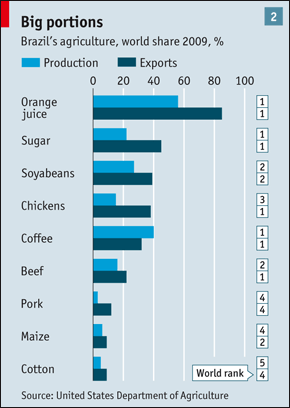
The increase in Brazil’s farm production has been stunning. Between 1996 and 2006 the total value of the country’s crops rose from 23 billion reais ($23 billion) to 108 billion reais, or 365%. Brazil increased its beef exports tenfold in a decade, overtaking Australia as the world’s largest exporter. It has the world’s largest cattle herd after India’s. It is also the world’s largest exporter of poultry, sugar cane and ethanol (see chart 2). Since 1990 its soyabean output has risen from barely 15m tonnes to over 60m. Brazil accounts for about a third of world soyabean exports, second only to America. In 1994 Brazil’s soyabean exports were one-seventh of America’s; now they are six-sevenths. Moreover, Brazil supplies a quarter of the world’s soyabean trade on just 6% of the country’s arable land.

No less astonishingly, Brazil has done all this without much government subsidy. According to the Organisation for Economic Co-operation and Development (OECD), state support accounted for 5.7% of total farm income in Brazil during 2005-07. That compares with 12% in America, 26% for the OECD average and 29% in the European Union. And Brazil has done it without deforesting the Amazon (though that has happened for other reasons). The great expansion of farmland has taken place 1,000km from the jungle.
How did the country manage this astonishing transformation? The answer to that matters not only to Brazil but also to the rest of the world.

An attractive Brazilian model
Between now and 2050 the world’s population will rise from 7 billion to 9 billion. Its income is likely to rise by more than that and the total urban population will roughly double, changing diets as well as overall demand because city dwellers tend to eat more meat. The UN’s Food and Agriculture Organisation (FAO) reckons grain output will have to rise by around half but meat output will have to double by 2050. This will be hard to achieve because, in the past decade, the growth in agricultural yields has stalled and water has become a greater constraint. By one estimate, only 40% of the increase in world grain output now comes from rises in yields and 60% comes from taking more land under cultivation. In the 1960s just a quarter came from more land and three-quarters came from higher yields.

So if you were asked to describe the sort of food producer that will matter most in the next 40 years, you would probably say something like this: one that has boosted output a lot and looks capable of continuing to do so; one with land and water in reserve; one able to sustain a large cattle herd (it does not necessarily have to be efficient, but capable of improvement); one that is productive without massive state subsidies; and maybe one with lots of savannah, since the biggest single agricultural failure in the world during past decades has been tropical Africa, and anything that might help Africans grow more food would be especially valuable. In other words, you would describe Brazil.

Brazil has more spare farmland than any other country (see chart 3). The FAO puts its total potential arable land at over 400m hectares; only 50m is being used. Brazilian official figures put the available land somewhat lower, at 300m hectares. Either way, it is a vast amount. On the FAO’s figures, Brazil has as much spare farmland as the next two countries together (Russia and America). It is often accused of levelling the rainforest to create its farms, but hardly any of this new land lies in Amazonia; most is cerrado.

Brazil also has more water. According to the UN’s World Water Assessment Report of 2009, Brazil has more than 8,000 billion cubic kilometres of renewable water each year, easily more than any other country. Brazil alone (population: 190m) has as much renewable water as the whole of Asia (population: 4 billion). And again, this is not mainly because of the Amazon. Piauí is one of the country’s driest areas but still gets a third more water than America’s corn belt.

Of course, having spare water and spare land is not much good if they are in different places (a problem in much of Africa). But according to BrasilAgro, Brazil has almost as much farmland with more than 975 millimetres of rain each year as the whole of Africa and more than a quarter of all such land in the world.
Since 1996 Brazilian farmers have increased the amount of land under cultivation by a third, mostly in the cerrado. That is quite different from other big farm producers, whose amount of land under the plough has either been flat or (in Europe) falling. And it has increased production by ten times that amount. But the availability of farmland is in fact only a secondary reason for the extraordinary growth in Brazilian agriculture. If you want the primary reason in three words, they are Embrapa, Embrapa, Embrapa.

More food without deforestation
Embrapa is short for Empresa Brasileira de Pesquisa Agropecuária, or the Brazilian Agricultural Research Corporation. It is a public company set up in 1973, in an unusual fit of farsightedness by the country’s then ruling generals. At the time the quadrupling of oil prices was making Brazil’s high levels of agricultural subsidy unaffordable. Mauro Lopes, who supervised the subsidy regime, says he urged the government to give $20 to Embrapa for every $50 it saved by cutting subsidies. It didn’t, but Embrapa did receive enough money to turn itself into the world’s leading tropical-research institution. It does everything from breeding new seeds and cattle, to creating ultra-thin edible wrapping paper for foodstuffs that changes colour when the food goes off, to running a nanotechnology laboratory creating biodegradable ultra-strong fabrics and wound dressings. Its main achievement, however, has been to turn the cerrado green.

When Embrapa started, the cerrado was regarded as unfit for farming. Norman Borlaug, an American plant scientist often called the father of the Green Revolution, told the New York Times that “nobody thought these soils were ever going to be productive.” They seemed too acidic and too poor in nutrients. Embrapa did four things to change that.

First, it poured industrial quantities of lime (pulverised limestone or chalk) onto the soil to reduce levels of acidity. In the late 1990s, 14m-16m tonnes of lime were being spread on Brazilian fields each year, rising to 25m tonnes in 2003 and 2004. This amounts to roughly five tonnes of lime a hectare, sometimes more. At the 20,000-hectare Cremaq farm, 5,000 hulking 30-tonne lorries have disgorged their contents on the fields in the past three years. Embrapa scientists also bred varieties of rhizobium, a bacterium that helps fix nitrogen in legumes and which works especially well in the soil of the cerrado, reducing the need for fertilisers.
So although it is true Brazil has a lot of spare farmland, it did not just have it hanging around, waiting to be ploughed. Embrapa had to create the land, in a sense, or make it fit for farming. Today the cerrado accounts for 70% of Brazil’s farm output and has become the new Midwest. “We changed the paradigm,” says Silvio Crestana, a former head of Embrapa, proudly.

Second, Embrapa went to Africa and brought back a grass called brachiaria. Patient crossbreeding created a variety, called braquiarinha in Brazil, which produced 20-25 tonnes of grass feed per hectare, many times what the native cerrado grass produces and three times the yield in Africa. That meant parts of the cerrado could be turned into pasture, making possible the enormous expansion of Brazil’s beef herd. Thirty years ago it took Brazil four years to raise a bull for slaughter. Now the average time is 18-20 months.

That is not the end of the story. Embrapa has recently begun experiments with genetically modifying brachiaria to produce a larger-leafed variety called braquiarão which promises even bigger increases in forage. This alone will not transform the livestock sector, which remains rather inefficient. Around one-third of improvement to livestock production comes from better breeding of the animals; one-third comes from improved resistance to disease; and only one-third from better feed. But it will clearly help.

Third, and most important, Embrapa turned soyabeans into a tropical crop. Soyabeans are native to north-east Asia (Japan, the Korean peninsular and north-east China). They are a temperate-climate crop, sensitive to temperature changes and requiring four distinct seasons. All other big soyabean producers (notably America and Argentina) have temperate climates. Brazil itself still grows soya in its temperate southern states. But by old-fashioned crossbreeding, Embrapa worked out how to make it also grow in a tropical climate, on the rolling plains of Mato Grosso state and in Goiás on the baking cerrado. More recently, Brazil has also been importing genetically modified soya seeds and is now the world’s second-largest user of GM after the United States. This year Embrapa won approval for its first GM seed.

Embrapa also created varieties of soya that are more tolerant than usual of acid soils (even after the vast application of lime, the cerrado is still somewhat acidic). And it speeded up the plants’ growing period, cutting between eight and 12 weeks off the usual life cycle. These “short cycle” plants have made it possible to grow two crops a year, revolutionising the operation of farms. Farmers used to plant their main crop in September and reap in May or June. Now they can harvest in February instead, leaving enough time for a full second crop before the September planting. This means the “second” crop (once small) has become as large as the first, accounting for a lot of the increases in yields.

Such improvements are continuing. The Cremaq farm could hardly have existed until recently because soya would not grow on this hottest, most acidic of Brazilian backlands. The variety of soya now being planted there did not exist five years ago. Dr Crestana calls this “the genetic transformation of soya”.
Lastly, Embrapa has pioneered and encouraged new operational farm techniques. Brazilian farmers pioneered “no-till” agriculture, in which the soil is not ploughed nor the crop harvested at ground level. Rather, it is cut high on the stalk and the remains of the plant are left to rot into a mat of organic material. Next year’s crop is then planted directly into the mat, retaining more nutrients in the soil. In 1990 Brazilian farmers used no-till farming for 2.6% of their grains; today it is over 50%.

Embrapa’s latest trick is something called forest, agriculture and livestock integration: the fields are used alternately for crops and livestock but threads of trees are also planted in between the fields, where cattle can forage. This, it turns out, is the best means yet devised for rescuing degraded pasture lands. Having spent years increasing production and acreage, Embrapa is now turning to ways of increasing the intensity of land use and of rotating crops and livestock so as to feed more people without cutting down the forest.
Farmers everywhere gripe all the time and Brazilians, needless to say, are no exception. Their biggest complaint concerns transport. The fields of Mato Grosso are 2,000km from the main soyabean port at Paranaguá, which cannot take the largest, most modern ships. So Brazil transports a relatively low-value commodity using the most expensive means, lorries, which are then forced to wait for ages because the docks are clogged.

Partly for that reason, Brazil is not the cheapest place in the world to grow soyabeans (Argentina is, followed by the American Midwest). But it is the cheapest place to plant the next acre. Expanding production in Argentina or America takes you into drier marginal lands which are much more expensive to farm. Expanding in Brazil, in contrast, takes you onto lands pretty much like the ones you just left.

Big is beautiful
Like almost every large farming country, Brazil is divided between productive giant operations and inefficient hobby farms. According to Mauro and Ignez Lopes of the Fundacão Getulio Vargas, a university in Rio de Janeiro, half the country’s 5m farms earn less than 10,000 reais a year and produce just 7% of total farm output; 1.6m are large commercial operations which produce 76% of output. Not all family farms are a drain on the economy: much of the poultry production is concentrated among them and they mop up a lot of rural underemployment. But the large farms are vastly more productive.

From the point of view of the rest of the world, however, these faults in Brazilian agriculture do not matter much. The bigger question for them is: can the miracle of the cerrado be exported, especially to Africa, where the good intentions of outsiders have so often shrivelled and died?

There are several reasons to think it can. Brazilian land is like Africa’s: tropical and nutrient-poor. The big difference is that the cerrado gets a decent amount of rain and most of Africa’s savannah does not (the exception is the swathe of southern Africa between Angola and Mozambique).

Brazil imported some of its raw material from other tropical countries in the first place. Brachiaria grass came from Africa. The zebu that formed the basis of Brazil’s nelore cattle herd came from India. In both cases Embrapa’s know-how improved them dramatically. Could they be taken back and improved again? Embrapa has started to do that, though it is early days and so far it is unclear whether the technology retransfer will work.

A third reason for hope is that Embrapa has expertise which others in Africa simply do not have. It has research stations for cassava and sorghum, which are African staples. It also has experience not just in the cerrado but in more arid regions (called the sertão), in jungles and in the vast wetlands on the border with Paraguay and Bolivia. Africa also needs to make better use of similar lands. “Scientifically, it is not difficult to transfer the technology,” reckons Dr Crestana. And the technology transfer is happening at a time when African economies are starting to grow and massive Chinese aid is starting to improve the continent’s famously dire transport system.

Still, a word of caution is in order. Brazil’s agricultural miracle did not happen through a simple technological fix. No magic bullet accounts for it—not even the tropical soyabean, which comes closest. Rather, Embrapa’s was a “system approach”, as its scientists call it: all the interventions worked together. Improving the soil and the new tropical soyabeans were both needed for farming the cerrado; the two together also made possible the changes in farm techniques which have boosted yields further.

Systems are much harder to export than a simple fix. “We went to the US and brought back the whole package [of cutting-edge agriculture in the 1970s],” says Dr Crestana. “That didn’t work and it took us 30 years to create our own. Perhaps Africans will come to Brazil and take back the package from us. Africa is changing. Perhaps it won’t take them so long. We’ll see.” If we see anything like what happened in Brazil itself, feeding the world in 2050 will not look like the uphill struggle it appears to be now.

Source - Economist.com